About Vireo gundlachii Lembeye, 1850
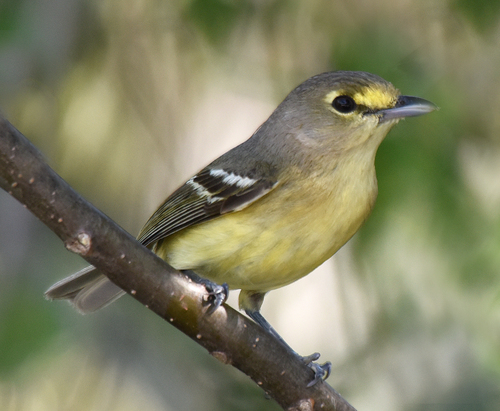
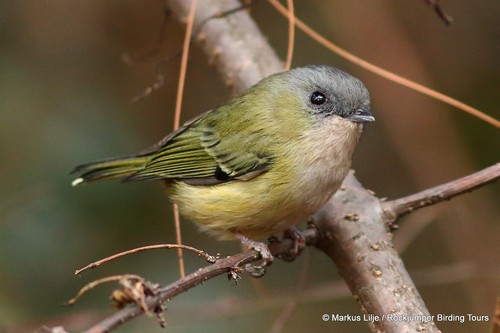
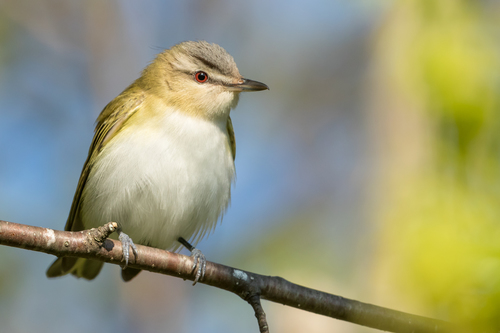
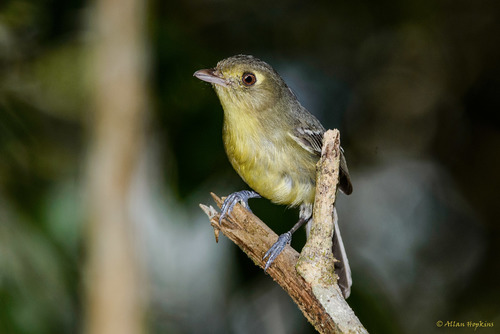
The Cuban vireo (Vireo gundlachii Lembeye, 1850) is about 13 cm (5.1 in) long and weighs approximately 11 to 15 g (0.39 to 0.53 oz). Males and females have identical plumage. Adults of the nominate subspecies V. g. gundlachii have an olive-gray crown, nape, and ear coverts. They have a yellow or creamy white patch that extends from the lores through the eye, and a grayish yellow area between the bill and the ear coverts. Their upperparts are olive-gray. Their wing coverts are brownish gray with small whitish or pale grayish tips that form two faint wing bars. Their flight feathers are brownish gray; the primaries and secondaries have pale yellowish edges along their outer webs. Their tail is brownish gray. Their throat and breast are yellowish, their belly and vent are a paler yellowish, their sides are a grayer yellowish, and their undertail coverts are yellow gray. They have a brown or reddish brown iris, a gray-brown maxilla, a paler mandible, and lead gray legs and feet. Juveniles are overall duller in color than adults. Subspecies V. g. magnus is larger than the nominate subspecies, with longer wings and tail, a less olivaceous back, and paler yellow underparts. V. g. sanfelipensis has a whitish (rather than yellow) chin and throat, and paler underparts than the nominate. V. g. orientalis has grayer upperparts and paler underparts than the nominate. The subspecies of the Cuban vireo have the following distribution: V. g. magnus is found on Cayo Cantiles, east of Isla de la Juventud (formerly called the Isle of Pines); V. g. sanfelipensis is found on Cayo Real, in the Cayos de San Felipe west of Isla de la Juventud; V. g. gundlachii is found across Cuba (including Isla de la Juventud) except in southeastern Cuba; V. g. orientalis is found in southeastern Cuba. The Cuban vireo primarily inhabits the edges of evergreen and deciduous forest, brushlands, thickets, and scrublands from sea level up to about 700 m (2,300 ft), but it also occurs at elevations higher than this.