About Vireo gilvus (Vieillot, 1808)
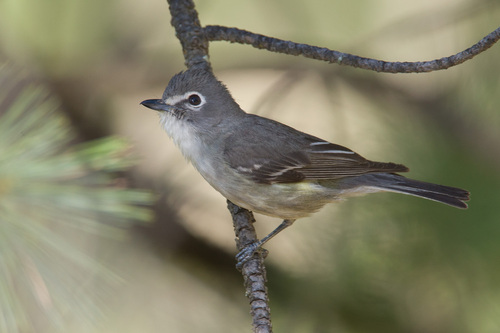
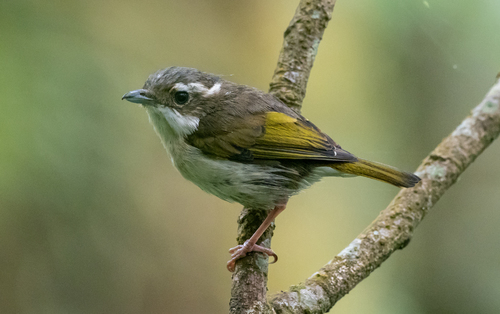
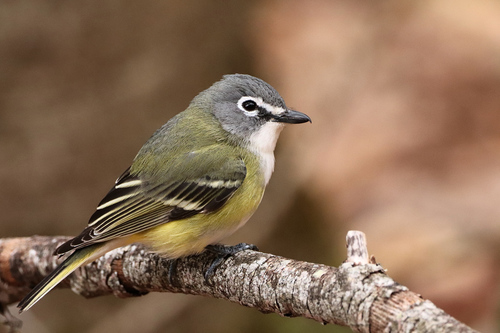
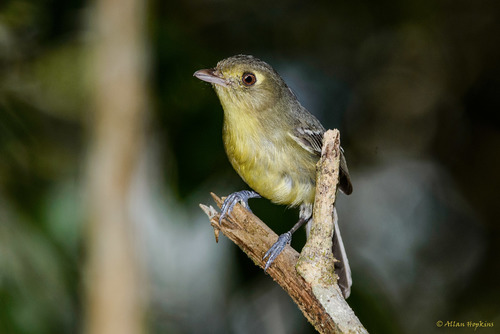
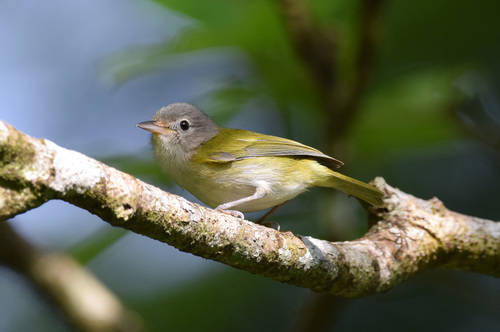
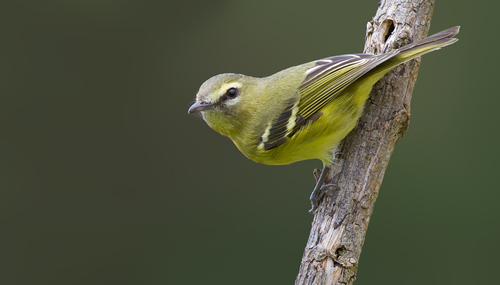
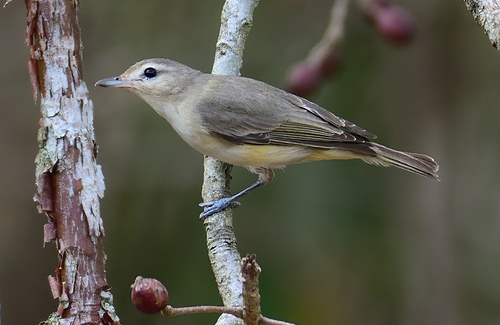
The warbling vireo, with the scientific name Vireo gilvus (Vieillot, 1808), is a small North American songbird. Its breeding range spans open deciduous and mixed woodlands from Alaska to Mexico. It most often nests in widely spaced cottonwood or aspen trees alongside streams or rivers, and migrates to Mexico and Central America for the non-breeding season. Its standard measurements are: length 12–13 cm (4.7–5.1 in), wingspan 22 cm (8.7 in), and weight 10–16 g (0.35–0.56 oz). Warbling vireos have olive-grey heads and upperparts, white underparts, brown eyes, a light-colored front of the face, a distinct white supercilium, thick blue-grey legs, and a stout bill. Individuals from western populations are generally smaller and have darker grey crowns than those from eastern populations. Warbling vireos forage for insects in trees by hopping along branches, and sometimes hover while foraging. They also eat berries, particularly before migration and during winter; like other vireos, they appear to favor gumbo-limbo seeds, but will not enter human-modified habitats to access these seeds. They build deep cup-shaped nests that are suspended from a tree branch or shrub; nests are placed relatively high in trees in eastern populations, and lower in trees in western populations. Males assist with incubation and may sing from the nest. The species' song is a cheerful warble, similar to the songs of the painted bunting and the purple finch. There are subtle differences in song between eastern and western warbling vireos, at least in areas where their ranges overlap in Alberta. Some authors propose splitting the eastern and western subspecies into two separate species. Under this split, the eastern warbling vireo (V. g. gilvus) breeds from central Alberta and northern Montana east and south through most of the United States and parts of southern Canada, outside the range of the western group. It winters south of the Isthmus of Tehuantepec, from south-central Chiapas to Nicaragua. It completes its autumn moult while still on its breeding grounds, unlike the western swainsonii group which completes its moult after leaving the breeding grounds. The proposed separate western species (Vireo swainsoni) includes two breeding subspecies: V. g. swainsoni, which breeds from southeastern Alaska and southwestern Northwest Territories to Sierra San Pedro Mártir, Baja California; and V. g. brewsteri, which breeds from southern Idaho, Wyoming, and Montana to south-central Oaxaca. These two subspecies winter in Mexico. The swainsoni group also includes V. g. victoriae, an isolated population that breeds in the Sierra de la Laguna, Baja California Sur, and migrates to currently unknown wintering grounds. The brown-capped vireo (Vireo leucophrys), a resident species of Central America and northern South America, is sometimes classified as the same species as the warbling vireo.