About Vireo flavoviridis (Cassin, 1851)
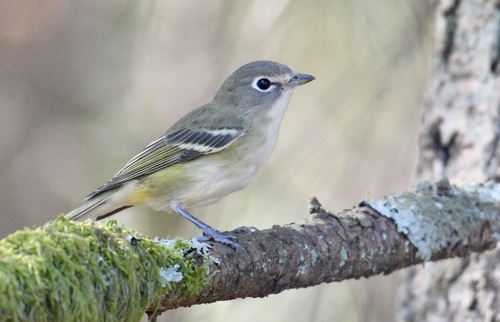
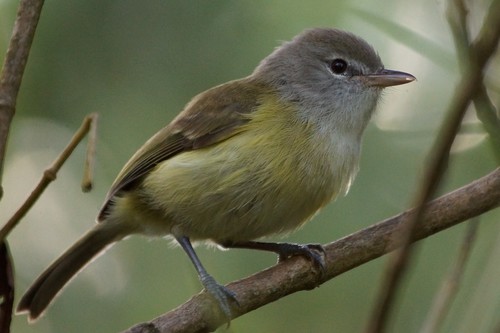
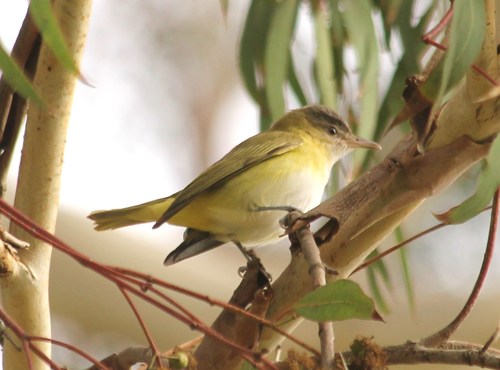
Description: The adult yellow-green vireo measures 14–14.7 cm in length and weighs 18.5 g. It has olive-green upperparts and a gray crown edged with dusky coloring. A dark line extends from the bill to its red-brown eyes, and it has a white supercilium. Its underparts are white, with yellow on the breast sides and flanks. Young yellow-green vireos are duller in color, have brown eyes, a brown tint to the back, and less yellow visible on their underparts. Adult yellow-green vireos differ from red-eyed vireos by having much yellower underparts, no black border around their duller gray crown, yellower upperparts, and different eye color. Some individuals cannot be easily distinguished from the similar red-eyed vireo, even when examined in hand, and the yellow-green vireo is sometimes considered conspecific with the red-eyed vireo. As a result, its exact status as a passage bird in countries such as Venezuela remains uncertain. The yellow-green vireo produces a nasal nyaaah call, and its song is a repetitive veree veer viree, fee'er vireo vireo that is shorter and faster than the song of the red-eyed vireo. This species rarely sings when it is on its wintering grounds. Distribution and habitat: This species breeds from southern Texas in the United States, where it occurs occasionally in the Rio Grande Valley, and from the western and eastern mountain ranges of northern Mexico – the Sierra Madre Occidental, Sierra Madre Oriental, and also the Cordillera Neovolcanica – south to central Panama. It is a migratory bird, and winters in the northern and eastern Andes and the western Amazon basin. This vireo lives in the canopy and middle levels of light woodland, at forest edges, and in gardens, at altitudes ranging from sea level to 1500 m.