About Vireo crassirostris (H.Bryant, 1859)
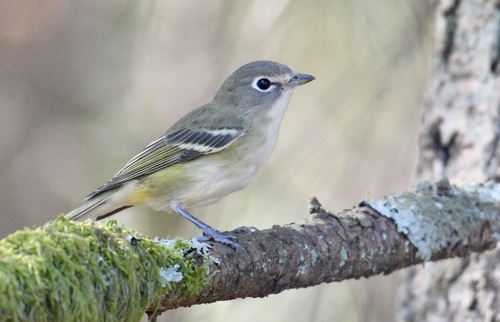
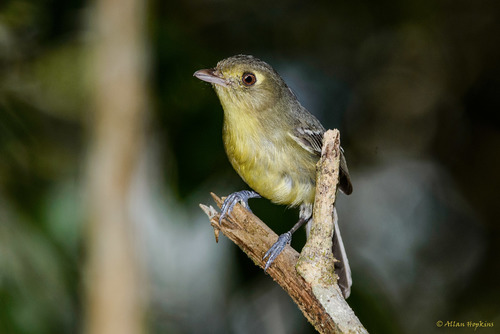
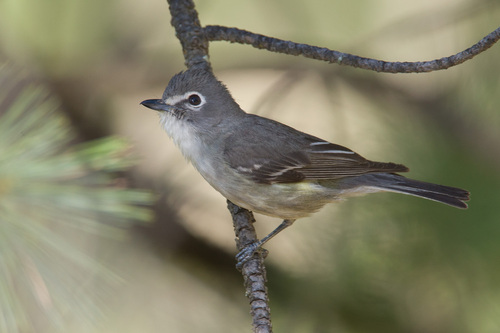
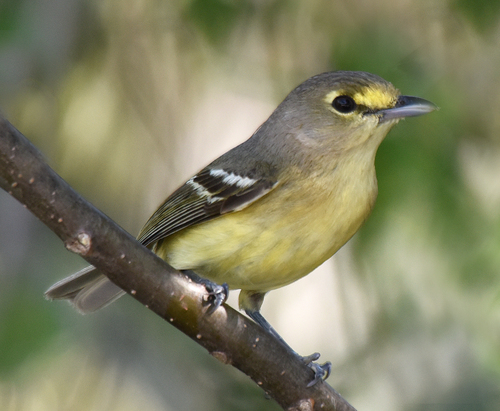
Vireo crassirostris, commonly called the thick-billed vireo, measures 11.5 to 13.4 cm (4.5 to 5.3 in) in length and weighs approximately 11 to 16 g (0.39 to 0.56 oz). Males and females have identical plumage. Adults of the nominate subspecies V. c. crassirostris have mostly grayish olive to brownish olive crowns, faces, and napes, paired with blackish lores, a pale yellow stripe above the lores, and a pale to darker yellow eye-ring that is sometimes incomplete. Their upperparts are grayish olive to brownish olive, while the rump and uppertail coverts are a more olive-green. Their wing coverts are dusky grayish brown with wide white tips that form two prominent wing bars. Their flight feathers are also dusky grayish brown: the primaries have off-white edges, the secondaries have pale olive edges, and the tertials have white edges. Their tail is dusky grayish brown. Their underparts range from pale grayish buffy to light yellowish buff or yellow. Other subspecies of the thick-billed vireo differ very little from the nominate subspecies. All subspecies have a dark iris, a dusky horn-colored maxilla, a pale horn-colored mandible, and bluish gray legs and feet.
Each subspecies of the thick-billed vireo has a distinct range: V. c. crassirostris is found in the Bahamas; V. c. stalagmium is found in the Turks and Caicos Islands; V. c. tortugae is found on Île de la Tortue off northern Haiti; V. c. cubensis is found on Cayo Coco and Cayo Paredón Grande off northern Cuba; V. c. alleni is found in the Cayman Islands. The species has also been recorded several times in Florida. The thick-billed vireo inhabits deciduous woodlands, scrublands, and mangroves.