About Vireo altiloquus (Vieillot, 1808)
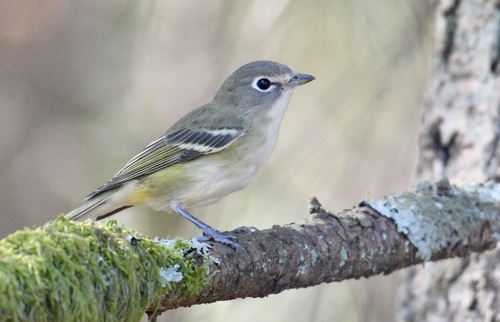
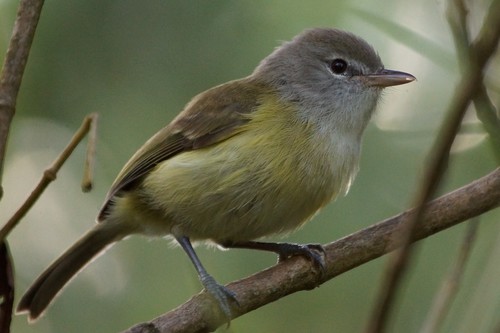
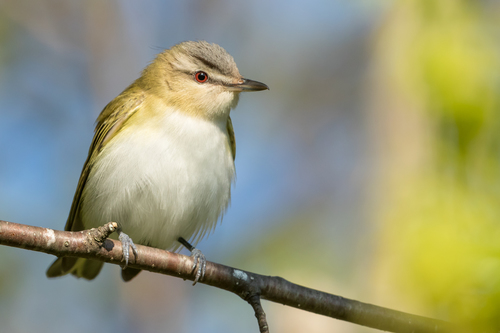
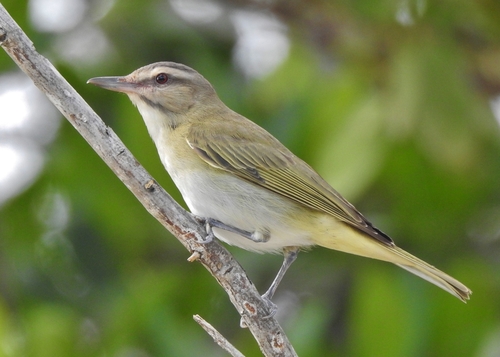
The black-whiskered vireo (Vireo altiloquus (Vieillot, 1808)) measures 15 to 16.5 cm (5.9 to 6.5 in) in length. The nominate subspecies V. a. altiloquus has an average weight of 18 g (0.63 oz). Males and females have identical plumage. Adult nominate subspecies have a bluish gray forehead and crown with a buff-olive tint, a buffy whitish supercilium that extends from the bill past the eye, a wide dusky stripe through the eye, and the species' namesake black "whisker" marking on the sides of the throat. Their nape and upperparts are olive-green. Their flight feathers (remiges) are mostly brownish black with small white tips, wide whitish or cream edges on the inner webs, and thin yellowish olive edges on the outer webs. Their tail feathers (rectrices) are mostly brownish with thin yellowish olive edges on the outer webs, and thin white or cream edges on the inner webs of the outer three pairs. Their underparts are mostly whitish, with a slight buff and greenish olive tint on the throat and upper breast, a pale olive wash on the sides and flanks, and lemon-yellow undertail coverts. Other subspecies differ from the nominate and each other in the following ways: V. a. barbatulus has a grayish-tinged olive back and rump, and whiter underparts than the nominate; V. a. barbadensis has a pale gray wash on the supercilium and lighter green upperparts than V. a. barbatulus; V. a. bonairensis has an olive-buff back and less buff on the underparts than the nominate; V. a. grandior has yellowish sides and flanks and pale yellow undertail coverts; V. a. canescens has grayish olive upperparts, and whitish sides, flanks, and undertail coverts. All subspecies have a reddish brown iris, a stout black bill, and black legs and feet. The black-whiskered vireo is distributed across southern Florida, the Bahamas, the Greater and Lesser Antilles, Providencia and San Andrés islands, the ABC islands, Trinidad and Tobago, and the mainland South American countries of Brazil, Colombia, Guayana, Suriname, and Venezuela. It also occurs casually or as a vagrant in Mexico, Belize, Costa Rica, Panama, along the U.S. Gulf Coast, on the U.S. East Coast from Virginia southward, in Bermuda, in French Guiana, and in Peru. Each subspecies has its own range: V. a. barbatulus breeds in southern Florida, the Bahamas, Cuba, and Little Cayman and Cayman Brac in the Cayman Islands, and winters in the Amazon Basin; V. a. altiloquus is resident on Hispaniola, breeds in Jamaica and Puerto Rico, winters in northern South America, and is casual on the U.S. Gulf Coast; V. a. barbadensis is primarily resident in the Lesser Antilles from St. Croix to Barbados; V. a. bonairensis is resident on Aruba, Bonaire, Curaçao, and Venezuela's Los Roques and Margarita islands; V. a. grandior is resident on Providencia Island; V. a. canescens is resident on San Andrés Island. The black-whiskered vireo lives in a variety of landscapes across its range. In Florida, it is found primarily in coastal mangroves and subtropical hardwood hammocks, and to a lesser extent in the edges of suburban woodlands. Across the Caribbean, it occurs in "all forest types at all elevations", including mangroves, coastal woodlands, hardwood forest on limestone, scrubby forest, and montane forest. In northern South America (Colombia, Venezuela, and the Guianas), it tends to favor the edges of moist to humid forest. In the Amazon Basin, it is found on edges and in clearings of both primary and secondary evergreen forest. One source records its elevation range from sea level to about 900 m (3,000 ft). However, the "all elevations" statement from another source extends its possible range to about 3,000 m (9,800 ft) on Hispaniola. It reaches 1,300 m (4,300 ft) in Colombia, 2,000 m (6,600 ft) in mainland Venezuela, and 1,000 m (3,300 ft) in Brazil.