About Vipera walser Ghielmi, Menegon, Marsden, Laddaga & Ursenbacher, 2016
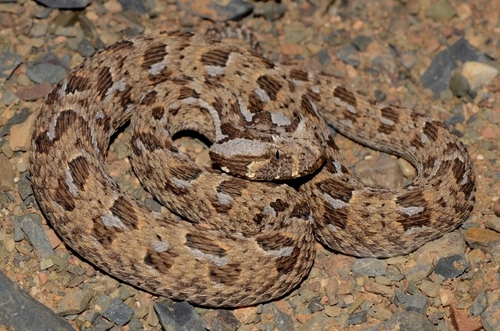
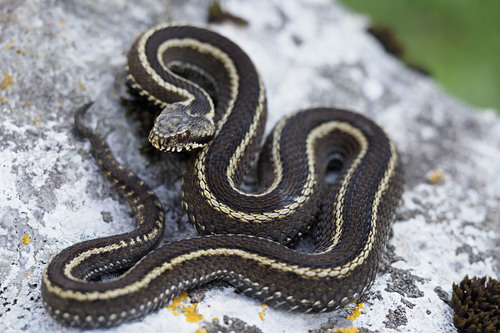
Morphologically, Vipera walser closely resembles the much more widespread Vipera berus. It differs from Vipera berus by having a higher number of cephalic scales, and more frequently shows fragmentation of the large cephalic shields. Additionally, most individuals of Vipera walser have 1.5 to 2 rows of subocular scales on both sides of the head, while Vipera berus usually only has a single row of these scales. The colouration of Vipera walser is highly variable: some specimens have the typical dorsal zigzag pattern, others have a reduced pattern made of horizontal bars, and melanistic individuals also occur.
Vipera walser is restricted to a small area in northeastern Piedmont, in the Italian Western Alps. It has two separate disjunct populations: the southern population, which covers approximately 225 km², is confined to an area of just 500 km² north of Biella, while the northern population covers approximately 45 km² in upper Valsesia.
Vipera walser lives in open habitats at altitudes between 1300 and 2300 m, in valleys that receive high precipitation. It is most often found on gentle south-facing slopes with low forest cover.