About Vipera ursinii (Bonaparte, 1835)
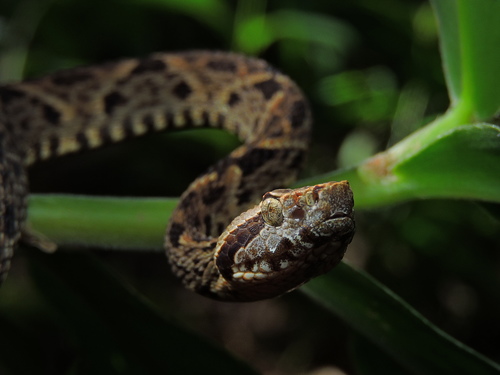
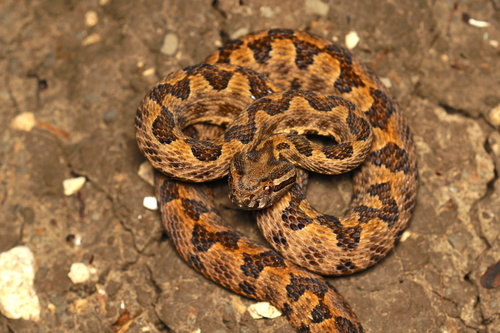
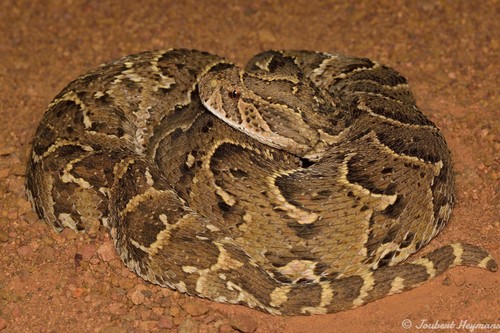
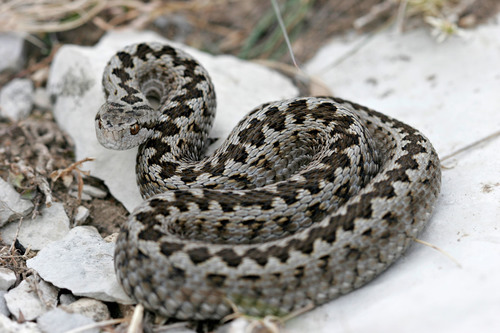
Adult meadow vipers (Vipera ursinii) have an average total length (including the tail) of 40–50 cm (15.75–19.69 inches), though larger specimens measuring 63–80 cm (24.8–31.5 inches) in total length have been recorded. Females of this species are larger than males. While Vipera ursinii is sometimes confused with Vipera aspis or Vipera berus, it can be distinguished from these two species by several key traits. It is the smallest viper found in Europe, with a thick body, narrow head, rough overall appearance, and a non-upturned snout. There are always several large scales or plates on the top of its head. Its prominently keeled dorsal scales are arranged in only 19 rows, and dark skin is often visible between these scales. Its base coloration is gray, tan, or yellowish, marked with a dark undulating dorsal stripe edged in black.
The known geographic range of Vipera ursinii includes southeastern France, eastern Austria (where it is now extinct), Hungary, central Italy, Serbia, Montenegro, Croatia, Bosnia and Herzegovina, northern and northeastern Republic of Kosovo, North Macedonia, Albania, and Romania. The species is considered likely extinct in Bulgaria, Moldova, and Ukraine. It is close to extinction in Hungary, and a record of the species from southeast Ukraine is considered unconfirmed. The subspecies Vipera ursinii rakosiensis is native to Hungary, though the taxonomic status of this subspecies remains disputed. The type locality for the species is given as "...monti dell'Abruzzo prossimi alla provincia d'Ascoli...", which translates to the mountains of Abruzzo near the Province of Ascoli Piceno, Italy.