About Vipera seoanei Lataste, 1879
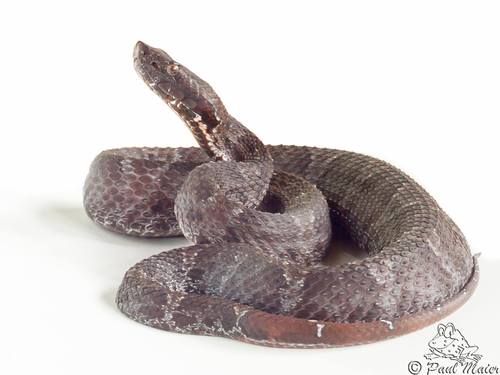
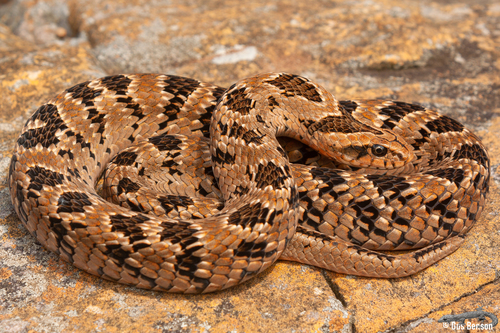
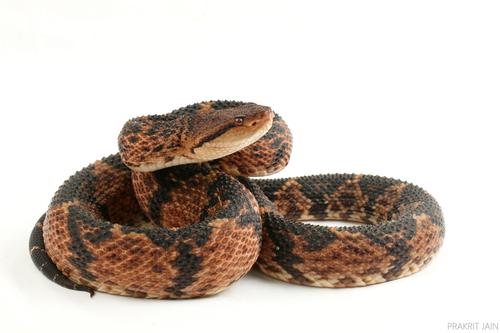
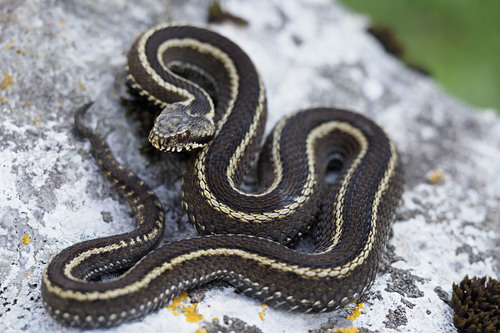
Vipera seoanei Lataste, 1879. Adult individuals of this species may reach a total length of 75 cm (30 inches) when including the tail, though most adults are smaller than this. It is a highly polymorphic species, and four main color-pattern morphs have been described. Morph A has a well-developed brown zigzag pattern running down its back, which closely resembles the pattern seen in Vipera berus; this pattern sits against a base ground color of beige or light gray. Morph B has a roughly twin-striped pattern, where the ground color forms two narrow, straight dorsolateral longitudinal lines along the body, and this morph somewhat resembles Vipera kaznakovi. Morph C is a uniform brownish morph that has no distinct pattern at all. Morph D has a fragmented zigzag pattern, also seen in the subspecies Vipera seoanei cantabrica. This species is distributed across extreme southwestern France, and the northern regions of Spain and Portugal. The originally given type locality for the species is "In montibus Gallaecorum et Cantabrorum...d'Espagne", which translates to the mountains of Galicia and Cantabrici, Spain. In 1928, Mertens and Müller proposed restricting the species' type locality to "Cabañas, Prov. Caruña, Spanien". Per the work of Golay et al. (1993), this restricted locality is Cabañas, located near Ferrol in A Coruña province, northwestern Spain.