About Vipera berus (Linnaeus, 1758)
Vipera berus (Linnaeus, 1758) is a relatively thick-bodied snake. Adults usually reach a total length of 60 cm (24 in, including tail), with an average length of 55 cm (22 in). Maximum adult size differs by region: the largest individuals, over 90 cm (35 in), are found in Scandinavia, where 104 cm (41 in) specimens have been observed twice. In France and Great Britain, the maximum size falls between 80–87 cm (31–34 in). Adult mass ranges from 50 g (1.8 oz) to approximately 180 grams (6.3 oz).
The head of Vipera berus is fairly large and distinct, with almost flat, vertical sides. The edge of the snout is usually raised into a low ridge. When viewed from above, the rostral scale is not visible, or only barely visible. Immediately behind the rostral, there are two small scales, rarely one. On the dorsal surface of the head, there are usually five large plates: a squarish frontal that is longer than wide, sometimes rectangular; two parietals, which sometimes have a tiny scale between the frontal and the parietals; and two long, narrow supraoculars. The supraoculars are large and distinct, and each is separated from the frontal by one to four small scales. The nostril sits in a shallow depression within a large nasal scale. The eye is relatively large, equal in size to or slightly larger than the nasal scale, but is often smaller in females. Below the supraoculars, there are six to 13 small circumorbital scales, most commonly eight to 10. Temporal scales are smooth, and only rarely weakly keeled. There are 10–12 sublabials and six to 10 supralabials, most commonly eight or nine. The third and fourth supralabials are the largest, while the fourth and fifth (rarely third and fourth) are separated from the eye by a single row of small scales; sometimes two rows in alpine specimens.
At midbody, there are 21 rows of dorsal scales, rarely 19, 20, 22, or 23. These scales are strongly keeled, except for the scales that border the ventral scales. The scales appear loosely attached to the skin, with lower rows growing increasingly wider. Scales closest to the ventral scales are twice as long as those along the midline. The number of ventral scales is 132–150 in males and 132–158 in females. The anal plate is single, while the paired subcaudals number 32–46 in males and 23–38 in females.
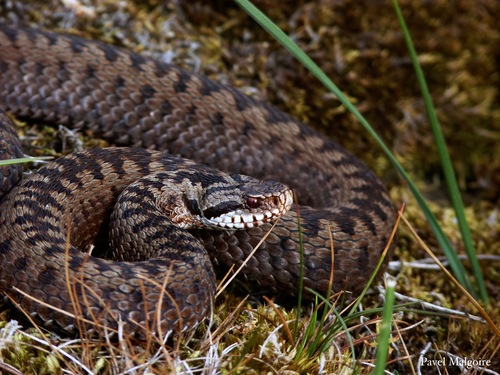
This species shows significant colour variation. Light-coloured specimens have small, incomplete dark crossbars on the back, while darker specimens have faint or clear darker brown markings. Melanistic individuals are completely black and lack any visible dorsal pattern. However, most specimens have a zigzag pattern running along the entire length of the back and tail. A distinctive dark V or X marking is usually present on the dorsal surface of the head. A dark streak extends from the eye to the neck, and continues as a series of longitudinal spots along the flanks. Unlike most snakes, the sexes of this species can often be distinguished by colour. Females are typically brown with dark brown markings, while males are a uniform grey with black markings. The base colour of males is often slightly lighter than that of females, making the black zigzag pattern more prominent. Melanistic individuals are most often female.
Vipera berus has an extensive range across the Eurasian landmass. It extends from northwestern Europe (Great Britain, Belgium, Netherlands, Scandinavia, Germany, France) across southern Europe (Italy, Serbia, Albania, Croatia, Montenegro, Bosnia and Herzegovina, North Macedonia, Bulgaria, and northern Greece) and eastern Europe to north of the Arctic Circle, through Russia to the Pacific Ocean, Sakhalin Island, North Korea, northern Mongolia and northern China. It is found farther north than any other snake species. The original type locality was listed simply as 'Europa'. Mertens and Müller (1940) proposed restricting the type locality to Uppsala, Sweden, and it was eventually restricted to Berthåga, Uppsala by neotype designation by Krecsák & Wahlgren (2008). In several European countries, it is notable as the only native venomous snake. It is also one of only three native snake species in Britain; the other two, the barred grass snake and the smooth snake, are non-venomous.
Sufficient habitat complexity is required for this species to occur, to support its behaviours including basking, foraging, and hibernation, as well as to provide protection from predators and human disturbance. It can be found in a wide variety of habitats: chalky downs, rocky hillsides, moors, sandy heaths, meadows, rough commons, woodland edges, sunny glades and clearings, scrubby slopes, hedgerows, rubbish tips, coastal dunes, and stone quarries. If dry ground is available nearby, it will enter wetlands, and can be found on the banks of streams, lakes, and ponds. In much of southern Europe, such as southern France and northern Italy, it occurs in either low-lying wetlands or at high altitudes. In the Swiss Alps, it may climb to about 3,000 m (9,800 ft). In Hungary and Russia, it avoids open steppeland, a habitat where V. ursinii is more commonly found. However, in Russia it does occur in the forest steppe zone.
In Hungary, mating takes place during the last week of April, while in the north it occurs later, during the second week of May. Mating has also been observed in June and even early October, but it is unknown whether autumn mating produces any offspring. Females typically breed once every two years, or even once every three years if seasons are short and climate is not favourable. Males locate females by following their scent trails, and can travel hundreds of metres per day. If a female flees after being found, the male will pursue her. Courtship involves a synchronised side-by-side 'flowing' movement, with the male flicking his tongue along the female's back and whipping his tail excitedly. Pairs stay together for one to two days after mating.
Males expel rival males and engage in combat. Combat often begins with the same flowing behaviour seen in courtship, before culminating in the dramatic 'adder dance'. During the dance, the males face each other, raise the front of their bodies vertically, make swaying movements, and attempt to push each other to the ground. This sequence is repeated until one male becomes exhausted and withdraws to find another mate. Appleby (1971) notes that he never observed an intruder win one of these contests, suggesting that the defending male becomes so frustrated during courtship that he refuses to accept defeat to retain his mating opportunity. No biting has ever been recorded during these contests.
Females usually give birth in August or September, but sometimes as early as July, or as late as early October. Litter sizes range from three to 20 young. Newborns are usually born encased in a transparent sac, and must free themselves from this membrane. Occasionally, they break free of the membrane while still inside the mother. Neonates measure 14 to 23 cm (5.5 to 9.1 in) in total length including the tail, with an average total length of 17 cm (6.7 in). They are born with a fully functional venom apparatus and a yolk reserve inside their bodies. They shed their first skin within one to two days of birth. Females do not show much interest in their offspring, but young have been observed to stay near their mothers for several days after birth.