About Vipera aspis (Linnaeus, 1758)
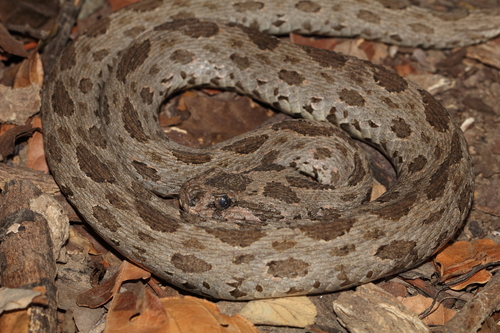
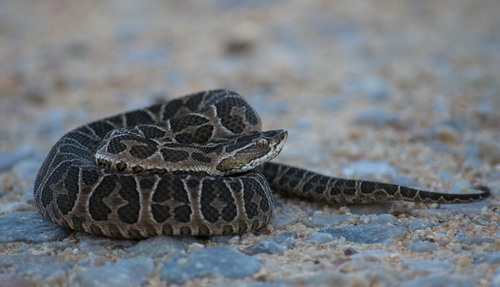
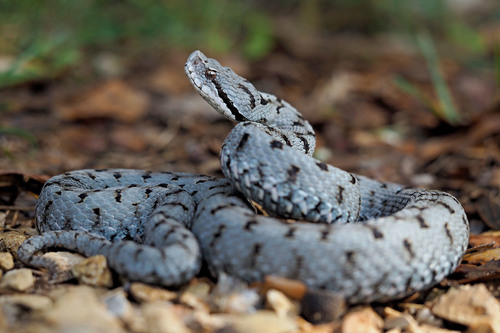
Vipera aspis (Linnaeus, 1758) reaches an average total length of 60–65 centimetres (24–26 in). Males grow to a maximum total length of 85 cm (33 in), while females rarely exceed 75 cm (30 in). Males are slightly slimmer than females. The species has a very short tail: in females, the tail makes up one-seventh to one-ninth of total body length, and in males it makes up one-sixth to one-eighth. The head is broad, triangular, and clearly distinct from the neck, with a slightly but definitely upturned snout tip. The rostral scale is generally taller than it is wide, and touches 2 to 3 scales on the upper surface of the snout. The dorsal surface of the snout is flat, with distinct, slightly raised, sharp margins. The nasal scale is almost always single, very rarely divided, and is separated from the rostral by a single nasorostral scale. The crown is covered with numerous small, irregular scales of varying sizes; these are mostly smooth, but may be slightly keeled. Frontal and parietal scales are usually absent. When present, they are small and irregularly shaped, and the frontal is separated from the supraoculars by 2 scale rows. The supraocular scales are large and distinct, and separated from each other by 4–7 scale rows. Below the supraocular, there are 10–12 small circumorbital scales, rarely 8–18. The eye is separated from the supralabials by 2 scale rows, rarely 3. The vertical diameter of the eye is approximately equal to the distance between the eye and the mouth. There are 9–13 supralabials. The 4th–5th supralabials, rarely the 4th–6th or 5th–6th, are separated from the eye by 2 rows of small scales, rarely 3, though sometimes a single scale sits between the 4th supralabial and the eye. Temporal scales are generally smooth, but may be slightly keeled. At midbody, there are 21–23 rows of dorsal scales, rarely 19 or 25. These dorsal scales are strongly keeled, except for the variable outermost rows, which are sometimes smooth. There are 134–170 ventral scales: subspecies V. a. aspis averages fewer than 150 ventral scales, while V. a. atra averages more. The anal scale is single. Males have 32–49 paired subcaudal scales, and females have 30–43 paired subcaudal scales. Dorsal body markings vary widely, and only rarely form the clear zigzag pattern seen in V. berus. This species is native to France, Andorra, north-eastern Spain, extreme south-western Germany in the southern Black Forest, Switzerland, Italy, and north-western Slovenia. Its original type locality was simply recorded as "Gallia", but Schwarz (1936) proposed restricting it to Poitou, France. The species has been extirpated from Bulgaria. Between August and October 2006, multiple specimens were discovered in a wooded area near the town of Poortugaal in the Netherlands. The population was surviving well, but the species is not native to the Netherlands; the snakes are thought to have either escaped from captivity or been intentionally released there. Vipera aspis has a small set of clear, relatively specific habitat requirements: it needs warm, sun-exposed areas, structured vegetation, and comparatively dry soil. In Italy and France, it is most often found in low mountain or hill areas, particularly in limestone regions, but may also occur in lower plains. It prefers vegetated areas or environments that offer at least some cover. Within these areas, it can be found on sunny slopes, in scrublands, glades, mountain meadows, forest clearings, along woodland borders, in rubbish dumps, and in stone quarries. In Italy, it occurs in mesic chestnut and oak woodlands, and is often found near streams. While it is not strongly associated with high elevations, it has been recorded at over 2,100 m (6,900 ft) above sea level in the Pyrenees.