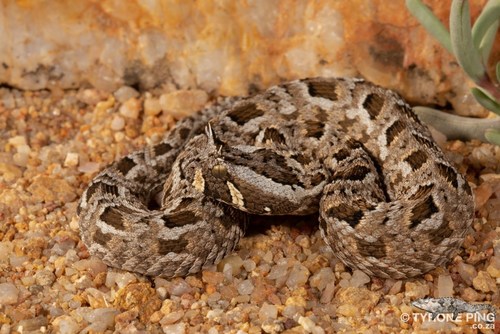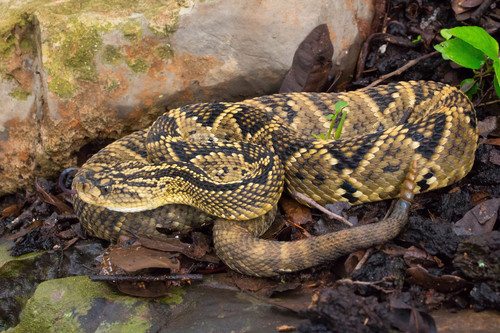
About Vipera ammodytes (Linnaeus, 1758)
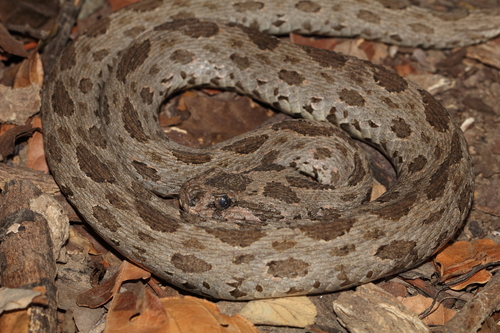
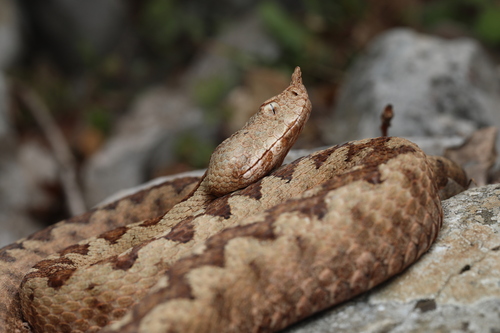
Vipera ammodytes (Linnaeus, 1758) has an average total snout-to-tail length of 85 cm (33.5 in), though most individuals are shorter than 75 cm (29.5 in). Maximum size varies by location, with northern populations being distinctly larger than southern ones. A field study on Golem Grad island, North Macedonia, found females averaged 35 cm long and males averaged 37 cm long; the largest individual captured in the study was a male measuring 66 cm, indicating regional or insular dwarfism in this population. The head is covered in small, irregular scales that are either smooth or weakly keeled, with a pair of large supraocular scales that extend past the posterior edge of the eye. Each eye is surrounded by 10 to 13 small scales, and two rows of scales separate the eye from the supralabials. The nasal scale is large, single (rarely divided), and separated from the rostral scale by a single nasorostral scale. The rostral scale is wider than it is long. The species’ most distinctive feature is a single “horn” on the snout, positioned just above the rostral scale. This horn is made up of 9 to 17 small scales arranged in two transverse rows, occasionally three or four. It reaches a length of roughly 5 mm (0.20 in) and is soft and flexible. In southern subspecies, the horn stands vertically upright, while in V. a. ammodytes it points diagonally forward. The body is covered in strongly keeled dorsal scales arranged in 21 to 23 rows at mid-body, rarely 25. Scales bordering the ventral scales are smooth or weakly keeled. Males have 133 to 161 ventral scales and 27 to 46 paired subcaudal scales, while females have 135 to 164 ventral scales and 24 to 38 paired subcaudal scales. The anal scale is single. Color pattern differs between males and females. In males, the head has irregular dark brown, dark gray, or black markings, with a thick black stripe running from behind the eye to behind the angle of the jaw. The tongue is typically black, and the iris is golden or coppery. Males often have a characteristic dark blotch or V-shaped marking on the back of the head that frequently connects to the dorsal zigzag pattern. Male base body color varies widely, including many different shades of gray, sometimes yellowish or pinkish gray, or yellowish brown. The dorsal zigzag stripe is dark gray or black, sometimes with a darker edge. A row of faint dark, occasionally yellowish, spots runs along each side of the body, and these spots are sometimes joined into a wavy band. Females have a similar overall color pattern, but it is less distinct and lower in contrast. They usually lack the dark blotch or V-shaped head marking seen in males. Female base color is variable, and tends more toward brown and bronze tones, including grayish-brown, reddish-brown, copper, dirty cream, or brick red. The female dorsal zigzag stripe is brown. Both sexes have a zigzag dorsal stripe set against a lighter background, and this pattern is often fragmented. Belly color varies: it can be grayish, yellowish-brown, or pinkish with heavy clouding or dark spots. In some individuals, the ventral color is black or bluish gray with white flecks and white-edged inclusions. The chin is lighter in color than the belly. The underside of the tail tip may be yellow, orange, orange-red, red, or green. Melanism occurs in this species but is rare. Juveniles have approximately the same color pattern as adults. Individuals have been found between railway rails and ballast prisms, accumulating solar heat in their bodies. This species has a geographic range covering northeastern Italy, Slovenia, Croatia, Bosnia-Herzegovina, Serbia, Montenegro, Albania, Kosovo, North Macedonia, Greece (including the Cyclades), southern Austria, Romania, Bulgaria, Turkey, Georgia and Syria. Its original listed type locality is “Oriente”; in 1936, Schwarz proposed restricting the type locality to “Zara”, modern Zadar, Croatia. The common name sand viper is misleading, because this species does not live in mostly sandy areas. Vipera ammodytes primarily lives in dry, rocky hillsides with sparse vegetation. It is not usually associated with woodlands, but when found there it occurs along edges and in clearings. It is sometimes found in areas of human habitation, including railway embankments, farmland, and especially vineyards where rubble piles and stone walls are present. At lower latitudes, it may be found above 2000 m. For reproduction, males engage in a combat dance with each other before mating, similar to the behavior of adders. Mating occurs in spring, from April to May. One to twenty live young are born in late summer or fall, from August to October. Newborn juveniles measure 14–24 cm (5.5–9.4 in) in total length. This species is ovoviviparous.