About Viola palustris L.
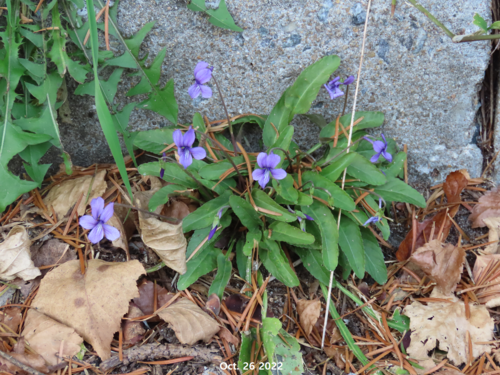
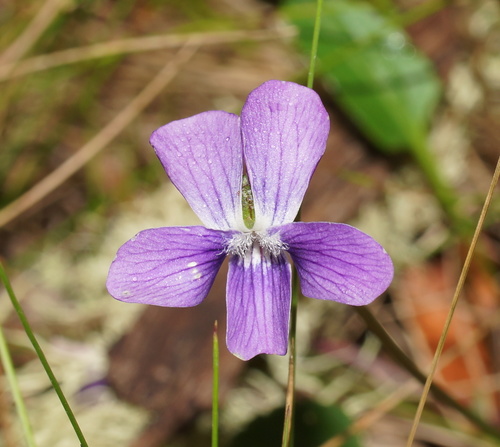
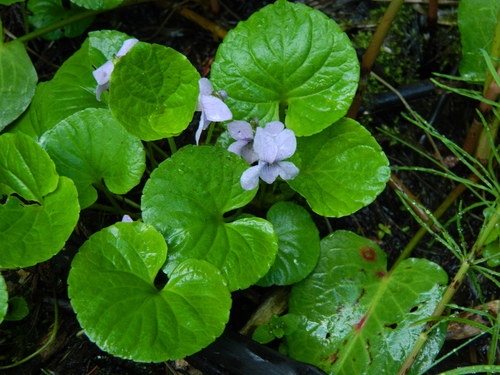
Viola palustris L. (marsh violet) is a perennial herb that reaches heights of 3 to 21.5 centimeters. In summer, it often forms small colonies connected by pale stolons, which root frequently and produce leaves at their nodes. This species also has slender, fleshy rhizomes, which are modified underground stems. All of its leaves grow from the plant's base rather than on aboveground stems, attached by hairless petioles that are 1 to 17 centimeters long. The leaves are unlobed, with hairless, crenulate margins (very fine rounded teeth). Leaf shape varies between reniform (kidney-shaped, with an indentation at the point of attachment), ovate (egg-shaped, wider toward the base), and orbiculate (circular). Leaves measure 0.5 to 6.4 centimeters long and 0.5 to 5.5 centimeters wide, and are roughly as long as they are wide. Flowers are typically lilac, pale blue, or pale violet on both sides, and are sometimes very pale, nearly white. They are 10 to 13 millimeters across. The lowermost central petal, and sometimes the two petals adjacent to it, have violet floral guides, and the lateral pair of petals are lightly bearded. Marsh violets are native to Europe, North America, a small area of northern Africa, and part of western Asia; in Asia, they only grow in Western Siberia, Russia. In Europe, it is native to almost every country, but is absent from southern Russia, Crimea (Ukraine), European Turkey, Albania, Sicily, Sardinia, the Svalbard archipelago, and the Balearic Islands. It is recorded as locally extinct in Hungary, and is also found in the Azores in the Atlantic Ocean. In North America, its range includes Greenland and most of Canada, with the exception of Yukon, Nova Scotia, New Brunswick, and Prince Edward Island. In the western United States, it grows in mountainous areas of Washington, Oregon, northern coastal California, Idaho, Montana, and Wyoming; it also grows in parts of Nevada and Utah, and has been reported from Arizona, Colorado, and South Dakota without specific localities. It is also recorded by the Natural Resources Conservation Service as native to the northeastern U.S. states of New York, Vermont, New Hampshire, and Maine. Marsh violets grow in marshes, fens, swamps, wet forests, and along stream banks, and can be found from sea level up to 1800 meters in elevation. Ecologically, Viola palustris serves as a larval food plant for the pearl-bordered fritillary (Boloria euphrosyne) and the small pearl-bordered fritillary (Boloria selene); small pearl-bordered fritillary prefers marsh violet, while pearl-bordered fritillary prefers common dog-violet (Viola riviniana). It is also used as a host plant by the dark green fritillary (Speyeria aglaja). It is a known host for two pathogenic fungi, Hendersonia violae and Puccinia fergussonii.