About Viola L.
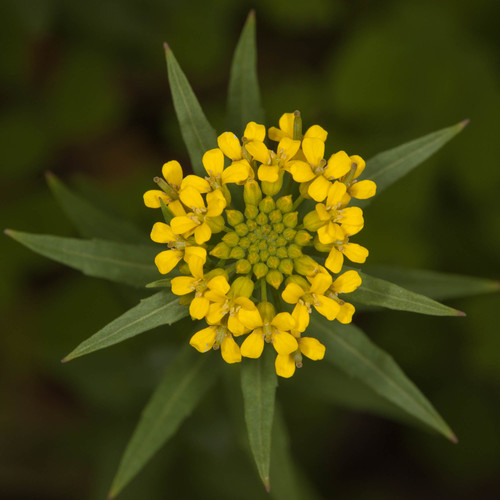
This species is an annual herbaceous plant with an appearance similar to many other mustards. It grows an erect stem 15–100 cm (5.9–39.4 in) tall, rarely reaching 150 cm. Its leaves range from lanceolate to elliptic in shape, 2–11 cm long and 0.5–1 cm broad, with margins that are entire to coarsely toothed. It blooms in summer, between June and August. Its flowers are bright yellow, 5–12 mm in diameter, and borne on an erect inflorescence. After flowering, it produces a slender cylindrical capsule 1–3 cm long, rarely up to 5 cm, which contains several small seeds that are pale brown or dark brown.
Erysimum cheiranthoides is native to temperate regions of Europe and Asia. Within its native Asian range, it occurs in the Chinese provinces of Heilongjiang, Jilin, Nei Monggol and Xinjiang, as well as in Japan, Korea, Mongolia and Siberia. In Europe, it is native to Eastern Europe (Belarus, Estonia, Latvia, Lithuania, Moldova and Ukraine), middle Europe (Austria, Belgium, the Czech Republic, Germany, Hungary, the Netherlands, Poland, Slovakia and Switzerland), Northern Europe (Denmark, Finland, Norway, Sweden and the United Kingdom), and Southeastern Europe (Bosnia and Herzegovina, Bulgaria, Croatia, France, Romania, Serbia and Slovenia). It is also widely naturalised outside its native range, including in New Zealand, additional parts of Europe, North America (including parts of Canada), and Argentina’s Tierra del Fuego.
It grows in disturbed areas, fields, and dry stream beds, and is typically found at altitudes between 0–3,000 m (0–9,843 ft) above sea level.
Like other members of the genus Erysimum, E. cheiranthoides produces two major classes of chemical defenses against herbivory: glucosinolates, which are characteristic of the plant family Brassicaceae, and cardiac glycosides called cardenolides, a class of chemicals produced by at least twelve different plant families. The glucosinolates found in E. cheiranthoides are glucoiberin, glucoerucin, glucocheirolin, and glucoiberverin. Cardenolides reported in E. cheiranthoides seeds include strophanthidin, digitoxigenin, cannogenol, erychroside, erysimoside, erycordin, cheiranthoside, glucoerysimoside, and glucodigifucoside. Grafting experiments and genetic crosses show that cardenolides are produced in the leaves of E. cheiranthoides and transported to other parts of the plant.
Some insect herbivores that specialise on crucifers do not readily feed or oviposit on E. cheiranthoides. Anthocharis cardamines, the orange tip butterfly, which oviposits on almost all crucifer species, avoids E. cheiranthoides. Similarly, the crucifer-feeding specialist Pieris rapae, the white cabbage butterfly, is deterred from feeding and ovipositing on E. cheiranthoides. However, another pierid species, Pieris napi oleracea, the green veined white butterfly, is less sensitive to exogenously added cardenolides than P. rapae in oviposition assays, and oviposits more readily on E. cheiranthoides leaves.
For P. rapae, oviposition experiments using E. cheiranthoides extracts sprayed onto Brassica oleracea, cabbage, identified both oviposition attractants and deterrents. 3-methylsulfinylpropyl glucosinolate and 3-methylsufonylpropyl glucosinolate stimulated oviposition, while erysimoside and erychroside from E. cheiranthoides extracts acted as deterrents. By contrast, another cardiac glycoside, erycordin, was inactive in this oviposition assay. Pieris rapae tarsal sensilla respond to both glucosinolates and cardenolides, indicating these compounds are detected on the leaf surface before oviposition. Consistent with the deterrent effects on oviposition, cardenolides from E. cheiranthoides leaf extracts also act as feeding deterrents for P. rapae caterpillars. However, P. rapae adults readily lay eggs and caterpillars feed on mutant E. cheiranthoides plants that do not produce cardenolides.
Predatory paper wasps (Polistes dominulus) take more time to consume Pieris napi caterpillars that fed on E. cheiranthoides than caterpillars that fed on Brassica oleracea, cabbage. This difference is attributed to the extra time wasps need to selectively remove the caterpillar guts, which contain plant material.
Because the genus Erysimum belongs to the family Brassicaceae, researchers have proposed that many existing genetic resources for Arabidopsis thaliana, an extensively studied model organism, can be used for genetic analysis of Erysimum. This makes the genus especially attractive for studying the cardenolide biosynthetic pathway. E. cheiranthoides itself is diploid with a relatively small genome of approximately 200 Mbp across 8 chromosomes. It can be grown from seed to seed production in as little as 10 weeks, and grows well in a laboratory setting. The genome of E. cheiranthoides variety Elbtalaue has been sequenced. Since E. cheiranthoides shares many genetic similarities with A. thaliana, it is likely that genetic modification and other research techniques developed for A. thaliana will also work for E. cheiranthoides. Mutated isolates of E. cheiranthoides with altered cardiac glycoside content have been identified.
Cardiac glycosides, which are abundant in E. cheiranthoides, have been used to treat heart disease and other ailments in both traditional and modern medicine. However, E. cheiranthoides is not a commonly used source of these compounds. It has still been used as an herbal remedy in traditional Chinese medicine. Sixteenth-century European herbalists used the plant as a remedy for insect and animal bites. Its common name, wormseed wallflower, comes from its historical use in treating intestinal worms.