About Viola cornuta L.
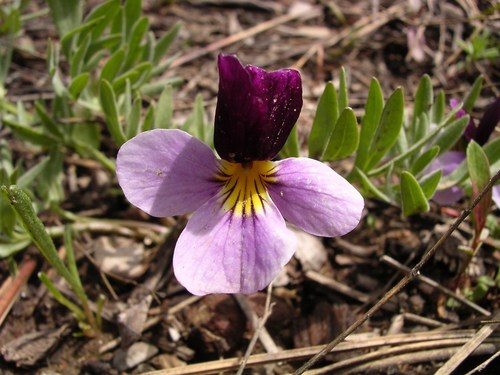
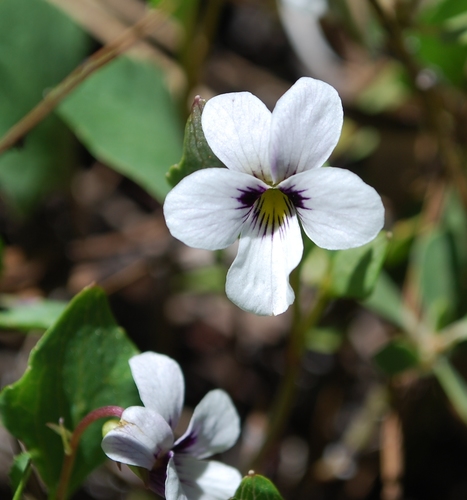
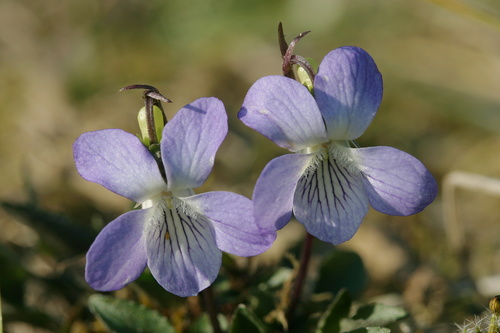
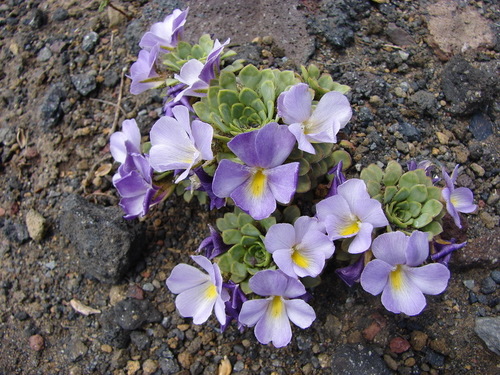
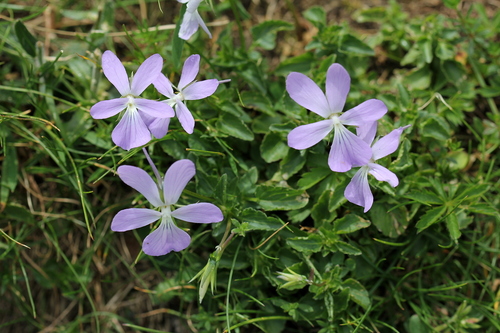
Viola cornuta, commonly called horned pansy or horned violet, is a flowering plant species that belongs to the violet family Violaceae. It is native to the Pyrenees and the Cordillera Cantábrica of northern Spain, where it grows at altitudes between 1,000 and 2,300 metres (3,300–7,500 ft). This is a low-growing, clump-forming temperate evergreen perennial, that reaches a maximum height and spread of 50 cm (20 in). It produces mid-green ovate leaves with rounded teeth, and great numbers of delicate pale violet flowers in early summer. Each flower has five strap-shaped petals and a slender spur. Both the species itself and its white-flowered Alba Group have received the Royal Horticultural Society's Award of Garden Merit. Viola cornuta is a confirmed host for the pathogenic fungus Puccinia violae. In cultivation, Viola cornuta is hardy to USDA zones 6–11, and in the United Kingdom it tolerates temperatures as low as −15 °C (5 °F). Most cultivated varieties are hybrids between this species and Viola × wittrockiana; these hybrids are classified as Viola × williamsii. Some of these hybrids, including the cultivar 'King Henry', can be hardy down to USDA zone 4.