About Vincetoxicum nigrum (L.) Moench
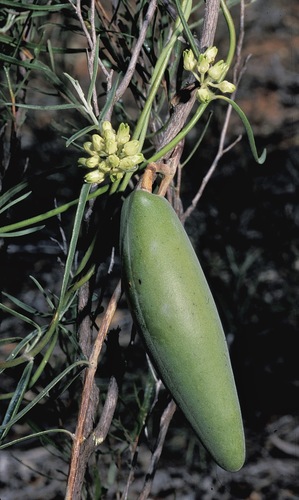
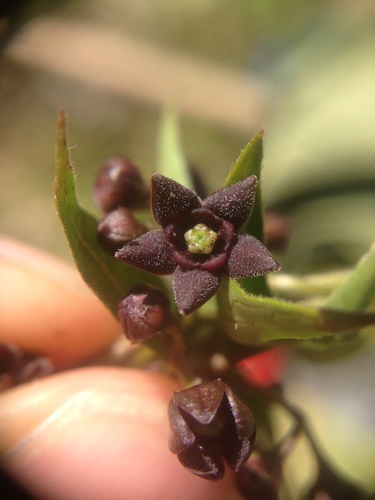
Vincetoxicum nigrum (L.) Moench is a perennial herbaceous vine. It produces ovate leaves with pointed tips, which measure 3–4 inches (7.6–10.2 cm) long and 2–3 inches (5.1–7.6 cm) wide, and grow in opposite pairs along the stem. Its flowers are star-shaped with five petals, covered in white hairs, and range in color from dark purple to black. The fruit is a slender, tapered follicle that changes color from green to light brown, and is densely filled with seeds. Each seed carries a fluffy pappus that enables wind dispersal. This species typically grows in upland areas and tolerates a wide range of light, salt, and moisture conditions. In the United States, it is commonly found in abandoned fields, hedgerows, brushy areas, woodlands, river banks, transportation corridors, quarries, agricultural fields, and gardens, where it is considered a fast-growing weed. Vincetoxicum nigrum emerges from an underground stem in spring, and flowers between June and July. It is self-pollinating, and follicles develop throughout the summer. The number of follicles a plant produces is directly related to the amount of light it receives: plants in lower light produce fewer follicles than plants exposed to higher light. Seed release begins by mid-August, and wind dispersal of seeds continues into early October. Each seed is polyembryonic, containing 1 to 4 embryos, which increases the species' ability to proliferate. The seeds have delicate fibrous parachute-like structures that allow wind dispersal over long distances. In addition to sexual reproduction via seeds, Vincetoxicum nigrum propagates vegetatively through rhizomes, allowing it to clone itself underground and produce new individual plants. After seeds are dispersed, the aboveground portion of the plant dies back to the ground over winter, and the plant regrows again the following spring.