About Vieja melanura (Günther, 1862)
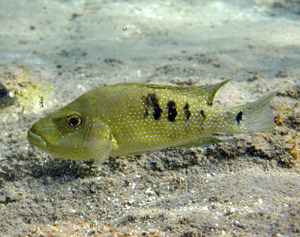
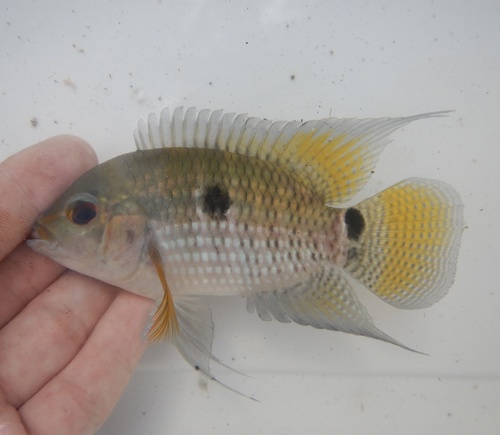
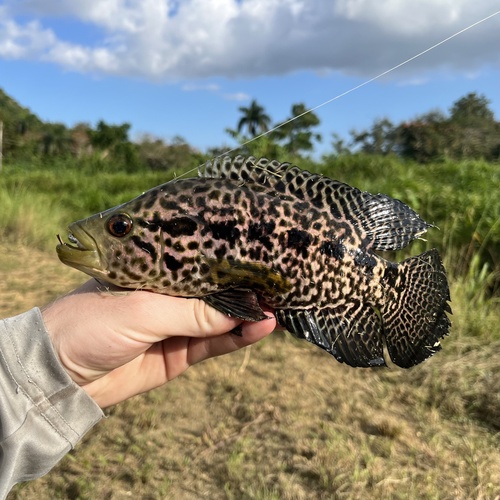
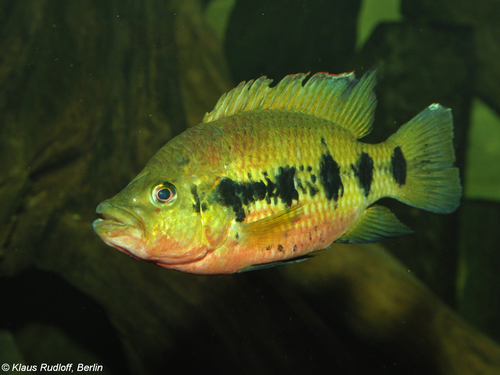
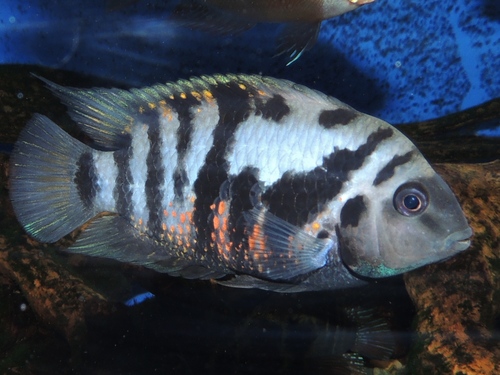
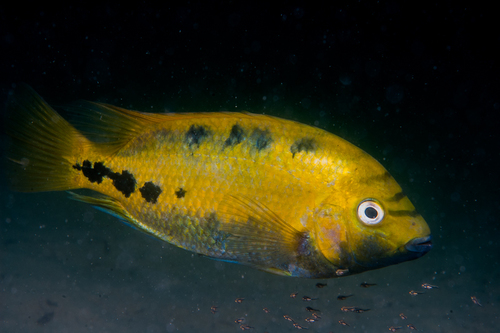
Vieja melanura, also called the redhead cichlid, is a brightly colored cichlid species popular in the aquarium trade. It can reach a total length of 35 cm (14 in), and is a sexually dimorphic species; males grow larger than females and develop a prominent nuchal hump on their forehead. Adults are quite colourful, with an orange to pinkish-red head, and a body that often displays green, blue, pink and golden-orange. A horizontal black bar, which is often patchy or mottled, sits at the base of the tail. Compared to other cichlid species, Vieja melanura has shorter heads, longer digestive tracts, and larger overall bodies. This species has a caudal (posterior) stripe that extends at a slight downward slope from the caudal peduncle, the rearmost part of the fish that connects the tail to the rest of the body, and covers about one-third of the fish's total body length. The belly and mottling elsewhere on the body can also be black. There are significant individual and geographical variations in this species' coloration; this variation is partially related to the water clarity of the fish's location. All adult Vieja melanura are robust, high-bodied cichlids, but there are additional regional morphological variations that depend on habitat. The caudal stripe was previously used to distinguish V. melanura from the synonymous species V. synspila, as well as several other species in the genus, until researchers found that stripe angle varies greatly between species. Researchers also discovered that in each individual fish, the right-side stripe slopes downward at a much sharper angle than the left-side stripe, and larger individuals have steeper sloped stripes. The slope of the caudal stripe also varies across V. melanura's native distribution range. Individuals from Belize have distinctly unique stripes; this is likely due to different habitat variables that produce a body morphology different from that of conspecifics in Mexico and Guatemala. Vieja melanura is native to the Atlantic slope of Central America, particularly in lowland areas including the Petén lake district, the Río Grijalva-Usumacinta system, and adjacent water systems of Mexico, Belize, Guatemala, and Costa Rica. It inhabits a wide variety of freshwater habitats, most often slow-moving or standing waters such as rivers, lakes and lagoons. This species is also tolerant of brackish environments. It has high survival rates in salinity environments up to 5 parts per thousand (ppt), but survival rates begin to fall in higher salinity environments, and mortality reaches 100% at 20ppt. On average, larger individuals are able to better tolerate higher salinity levels. This tolerance to brackish environments makes V. melanura an invasion threat to non-native waters. Through the aquarium trade, it has been introduced to many water systems around the globe, including areas of the United States and Asia. It has been found in the Kallang River at Bishan-Ang Mo Kio Park, Singapore, which was rehabilitated for urban use between 2009 and 2011. Since its introduction, it has spread both upstream and downstream into the surrounding waterways, where it dominates native endemic species. The redhead cichlid is oviparous and highly fecund. It reaches sexual maturity at 10 cm in length; females can produce around 300-500 fry per spawning, and can lay up to 1000 eggs per year. Males and females form stable bonded pairs and work together to raise their brood. Before spawning, the pair selects a site, usually a rock or a cave, and prepares it for their future brood by cleaning and clearing detritus from the site. Once the site is clean, the pair spawns and eggs are laid. Fry hatch within 2–3 days, and become free swimming by 4 days after laying. The bonded pair exhibits parental care toward their young spawn, but once they are ready to mate again, they become aggressive toward the fry and drive them off the breeding ground.