About Vidua macroura (Pallas, 1764)
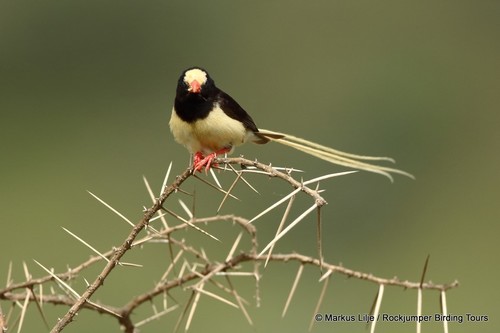
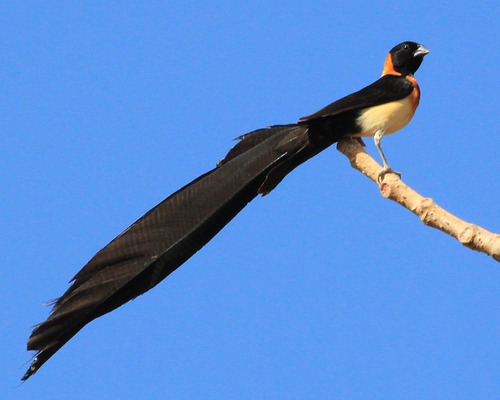
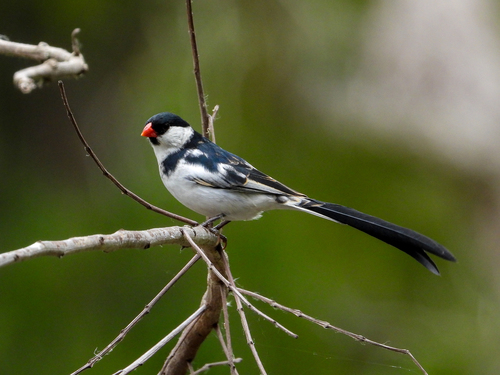
The pin-tailed whydah, Vidua macroura, has a body length of 12–13 cm; the breeding male’s tail adds an extra 20 cm to its total length. Adult breeding males have a black back, black crown, and a very long black tail. Their wings are dark brown with white patches, while their underparts and most of the head (excluding the crown) are white, and their bill is bright red. Females and non-breeding males have streaked brown upperparts, whitish underparts with buff flanks, and a mixed buff and black face pattern. They do not have the long tail extension, but still have a red bill. Immature pin-tailed whydahs look similar to females, but are plainer and have a greyish bill. This species is found across most of sub-Saharan Africa, where it prefers grassland, scrub, and savannah habitats, and also occurs in parks and gardens. It has an established wild population in the area around Aveiro, Portugal, with observations of the species recorded both north and south of Aveiro. It has been introduced to southern California, where it has a sizable wild population, and also to Puerto Rico and Singapore. It can be kept as a domesticated pet in the United States, and is widely kept as a cage bird in other regions, with occasional escapes and releases of captive birds. The pin-tailed whydah is a brood parasite that lays its eggs in the nests of estrildid finches, most commonly waxbills. Unlike the common cuckoo, it does not destroy the host’s existing eggs. It typically adds 2–4 of its own eggs to the host’s existing clutch. Both the host’s eggs and the pin-tailed whydah’s eggs are white, though the whydah’s eggs are slightly larger. Nestling pin-tailed whydahs mimic the gape pattern of the host species’ own fledglings. Male pin-tailed whydahs are territorial; one male usually has several females in his small social group. Males perform an elaborate courtship flight display that includes hovering over females to display their long tail. Males sing from a high perch, and their song is made up of rapid squeaking and churring. The diet of the pin-tailed whydah is made up of seeds and grain.