About Vidua chalybeata (Statius Muller, 1776)
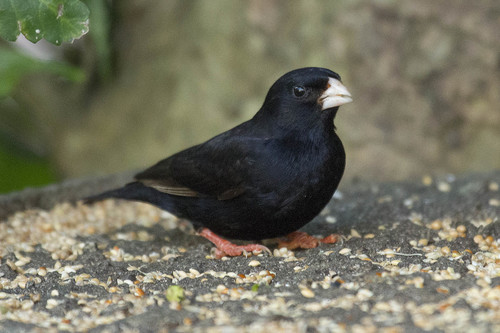
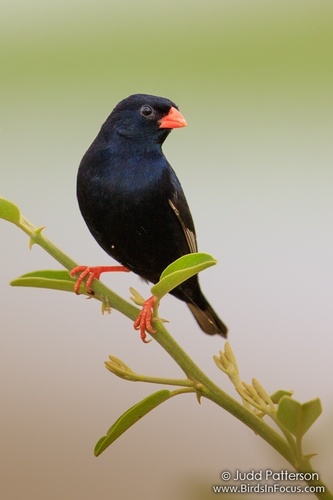
The village indigobird, scientifically named Vidua chalybeata (Statius Muller, 1776), measures 11–12 cm in total length. Adult males are entirely greenish-black or bluish-black, with the only exceptions being their orange-red legs and conical white bill. Females resemble female house sparrows: they have streaked brown upperparts, buff underparts, a whitish supercilium, and a yellowish bill, and they also have red legs. Immature village indigobirds look similar to adult females, but are plainer and lack a supercilium. Most indigobird species are very similar in appearance; males are hard to tell apart in the field, and young birds and females are nearly impossible to distinguish. Useful identifying clues for the village indigobird are its association with its host species, the red-billed firefinch, and its occurrence near human settlements. It is a resident breeding bird found across most of Africa south of the Sahara Desert. This indigobird lives in a wide range of open habitats, including open woodland, scrub, and cultivated land. As its common name suggests, it is most easily spotted near villages.