About Vicugna vicugna (Molina, 1782)
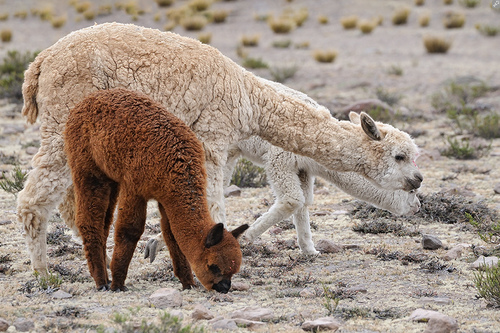
The vicuña (Vicugna vicugna) is smaller, more delicate, and more gracile than the closely related guanaco. A key morphological difference between the two species is that the guanaco has better-developed incisor roots. Compared to the guanaco, the vicuña has a slightly shorter head and slightly longer ears. The vicuña has a long, woolly coat that is tawny brown on its back, while the hair on its throat and chest is white and quite long. The combined head-and-body length of the vicuña ranges from 1.45 to 1.60 meters (about 5 feet), shoulder height ranges from 75 to 85 centimeters (around 3 feet), and body weight ranges from 35 to 65 kilograms (under 150 pounds).
Currently, vicuñas are only found in the central Andes of South America, occurring in Peru, northwestern Argentina, Bolivia, and northern Chile. A smaller introduced population of vicuñas lives in central Ecuador. Fossil remains show that vicuñas also ranged as far as Uruguay and the Straits of Magellan until the early Holocene, where they lived alongside the related guanaco.
Vicuñas inhabit areas at altitudes between 3,200 and 4,800 meters (10,500 to 15,700 feet). They feed on grassy plains of the Andes Mountains during the day, and spend nights on the mountain slopes. In these high-altitude habitats, only nutrient-poor, tough bunch grasses and Festuca grasses grow. The thin high-altitude atmosphere allows the sun's rays to penetrate easily, creating relatively warm daytime temperatures, but temperatures drop to freezing at night. The vicuña's thick but soft coat is a unique adaptation that traps layers of warm air close to its body, allowing it to tolerate freezing nighttime temperatures. The chief predators of vicuñas are pumas, culpeos, and domestic dogs.