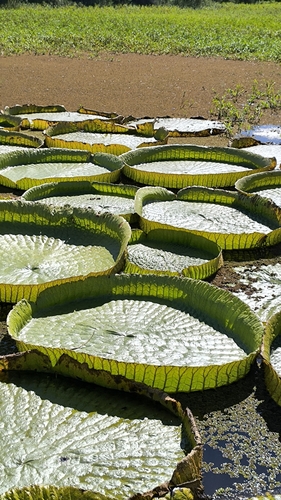
About Victoria cruziana A.D.Orb.
This species, known as Victoria cruziana A.D.Orb., is a popular water garden plant that is commonly grown in botanical gardens, where its very large leaves can reach their maximum full size. The leaves can grow up to 2 m wide, with a thick, raised rim that reaches up to 20 cm high; rims as tall as 23 cm have been recorded. It can tolerate cultivation in cooler water than the other two known species in its genus Victoria: the more widely familiar giant waterlily Victoria amazonica, and the more recently discovered Victoria boliviana. Its flowers reach 25 cm in diameter and bloom for only two days. Flowers emerge from underwater buds, opening white on the first day, then turn deep pink on the second and final day of blooming. Victoria cruziana is a thermogenetic, heat-producing plant. Its floral stigmas are attached to a cup that is protected by spines. This floral cup begins heating up while the flower is still a bud. When the flower opens, it releases a strong sweet scent to attract pollinating beetles from the genus Cyclocephala, in the family Scarabaeidae, and continues producing heat to maintain temperature within the flower while the beetles carry out pollination.