About Victoria amazonica (Poepp.) Sowerby
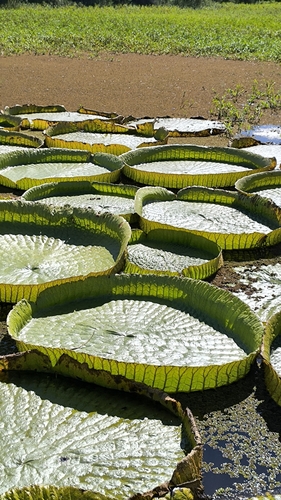
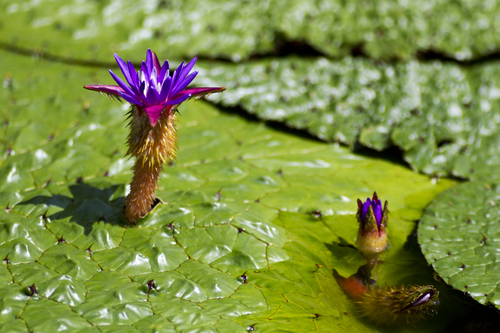
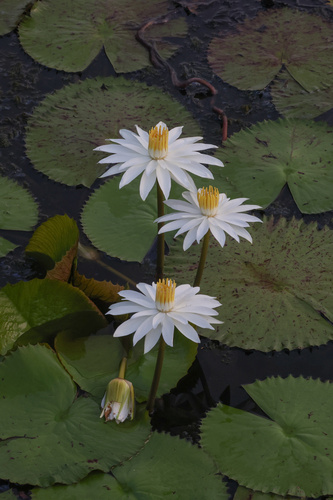
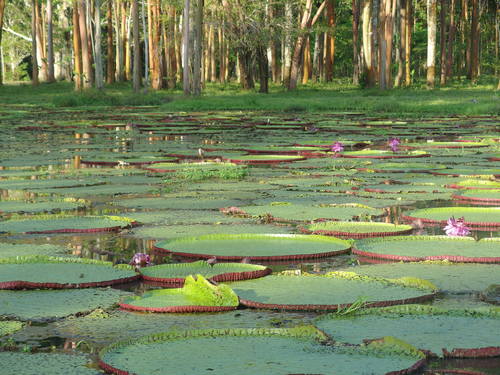
Victoria amazonica has very large floating leaves, commonly called pads or lily pads, that can reach up to 3 m (10 ft) in diameter. These leaves float on the water surface attached to a submerged stalk, or petiole, that is 7–8 m (23–26 ft) long — a length that rivals that of the green anaconda, a snake native to this species' habitat. When weight is evenly distributed across the entire leaf surface, the leaves are extremely buoyant; for example, a neutral-buoyancy plywood sheet placed evenly will be supported. In 1896, a V. amazonica leaf at Tower Grove Park, Saint Louis, Missouri supported the unprecedented weight of 110 kg (250 lb). However, in 1867 William Sowerby of Regents Park Botanic Garden in London placed 194 kg (428 lb) on a leaf that was only 168 cm (66 in) in diameter. One leaf from a specimen grown in Ghent, Belgium supported a load of 226 kg (498 lb). V. amazonica is the second-largest waterlily in the world. Both leaves and flowers grow from a perennial rhizome that can grow up to 20 cm (7.9 in) thick. This rhizome can live at least 7 years, but it often lives much shorter lives, frequently being annual, due to seasonal fluctuations in water levels. Thanks to internal air spaces within the leaf, the structure is surprisingly light. Laurent Saint-Cricq, who wrote under the pen name "Paul Marcoy", found that a leaf 2.6 m (8 ft 6 in) in diameter weighed only 6.1 kg (13 lb). V. amazonica is native to still and slow-moving waters in the Amazon River basin and other northern South American drainage basins, growing in water up to 5.25 m deep. In its native habitat, flowers begin to open as the sun sets, and can take up to 48 hours to fully open. These flowers can grow up to 40 cm (16 in) in diameter and 1.6 kg (3.5 lb) in weight; only members of the genus Rafflesia produce heavier flowers. On any given evening, all flowers on a single individual will be in either the female phase or the male phase. This means pollination must occur from a different individual, preventing self-pollination. The stem and underside of the leaves are covered in many small spines. These spines defend the plant from fish and other underwater herbivores, and also serve an offensive role: as the lily unfolds to seek out and capture sunlight, the spines can crush nearby rival plants. The large leaves also block sunlight from reaching other plants directly beneath them, significantly darkening the water below. Younger giant water lilies are even known to swing their spiny stalks and buds as they grow to forcibly make space for themselves. Each plant produces flowers continuously through a full growing season. It has co-evolved a mutualistic pollination relationship with a scarab beetle species from the genus Cyclocephala. All flower buds in a single patch will begin opening at the same time, and release a fruity scent as they open. At this opening stage, flower petals are white, and beetles are attracted by both the color and the scent. At nightfall, the flower stops producing scent and closes, trapping beetles inside its carpellary appendages. Inside the closed flower, stamens are protected by paracarpels, and the flower remains closed through the next day. The cavity holding the trapped beetle is made of spongy, starchy tissue that provides the beetle with nourishment. During this day of confinement, the plant releases anthocyanins, which change the petal color from white to reddish pink; this color change signals the flower has been pollinated. While the beetle feeds inside the flower, stamens fall inward, and anthers that have already detached drop pollen onto the stamens. On the evening of the second day, the flower opens enough to release the beetle. As the beetle pushes out through the stamens, it becomes covered in new pollen. The pollen-covered beetle will then go on to find a newly opened V. amazonica flower, and pollinate it with the pollen it carries. This full process was described in detail by Sir Ghillean Prance and Jorge Arius. V. amazonica is cultivated in botanical gardens around the world. It requires warm water temperatures of 29–32°C (85–90°F) for optimal growth; mature plants can tolerate slightly cooler conditions, between 24–27°C (75–80°F). Propagation is primarily done by seed, which must be stored submerged in water and scarified to speed up germination. Propagation can also be done via rhizome division during the growing season. In temperate regions, V. amazonica is grown as an annual, planted in containers with organically rich loam substrate placed in still water 1–3 m deep.