About Vicia sativa L.
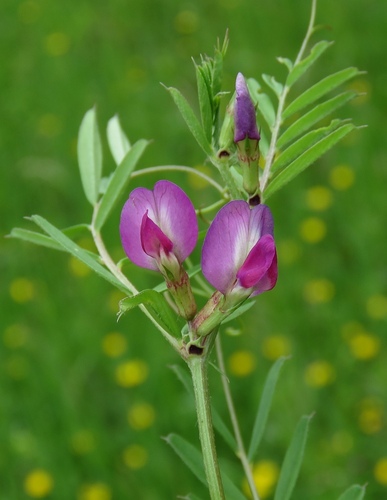
Vicia sativa L. is a sprawling annual herb. It has hollow, four-sided stems that range from hairless to sparsely hairy, with a maximum length of up to two meters. Its leaves are stipulate, alternate, and compound; each leaf is made up of 3 to 8 opposite pairs of leaflets that may be linear, lance-shaped, oblong, or wedge-shaped, and end in a needle tip, with each leaflet reaching up to 35 millimeters (1+1⁄2 inches) long. Every compound leaf terminates in a branched tendril. Its pea-like flowers grow in leaf axils, either solitary or in pairs. The flower corolla measures 1 to 3 centimeters (1⁄2–1+1⁄4 inches) long and is typically bright pink-purple, more rarely whitish or yellow. Bumblebees are the main visitors to these flowers. The fruit is a legume pod that can reach 6 to 7 centimeters (2+1⁄4 or 2+3⁄4 inches) long. When new, the pod is hairy; it becomes smooth as it matures, and turns brown or black when ripe. Each pod contains 4 to 12 seeds. This species is sown for use as fodder. When grown for fodder, seed is sown densely, at a rate of up to 250 kilograms per hectare (220 lb/acre). When grown for seed production, less seed should be sown. If too much seed is used, the crop becomes too thick, which reduces flower and seed production. For seed production, sowing is done early in the planting season to get good yields. For use as green manure, sowing can be done at any time in spring. Sometimes a full crop can grow even when sown as late as summer, though this late sowing is not recommended. After sowing seed and carefully harrowing the land, a light roller should be pulled across the field to smooth the surface, which allows the scythe to work without interruption. The field should also be monitored for several days after sowing to prevent pigeons from eating too much of the sown seed. Horses thrive very well when fed common vetch, even better than they do on clover and rye grass. Common vetch also works well for fattening cattle, which gain weight faster on vetch than on most grasses or other forage plants. Danger can occur when livestock eat too much vetch, especially vetch with pods. Excessive consumption can lead to colics and other stomach disorders. Vicia sativa can be sown alongside cereal grains, where it uses the stronger cereal stems for support by attaching to them via its tendrils. When grown with oats or other grasses, vetch can grow upright; without this support, its weak stems sprawl along the ground. Several agricultural cultivars are available, and like some other legume crops, rhizobia can be added to the seed before sowing. Pests that attack this crop include the powdery mildew fungus Erysiphe pisi, the pea aphid Acyrthosiphon pisum, the corn earworm (Heliothis zea), the fall armyworm (Spodoptera frugiperda), and spider mites of the genus Tetranychus. During the early 20th century, a mutant of common vetch emerged that produced lens-shaped seeds similar to those of lentils. This mutant often invaded lentil fields. In 1959, D. G. Rowlands demonstrated that this trait was caused by a single recessive mutation. The shift from traditional winnowing to mechanized farming largely solved this problem. Improved varieties of Vicia sativa developed by the National Vetch Breeding Program for Australian farmers include Timok, Volga, Rasina, and more recently Studenica. These varieties are mostly cultivated in Western Australia, South Australia, and Victoria. In 2019, Australian farmers grew Vicia sativa on more than 500,000 hectares (1,200,000 acres) per year.