About Viburnum tinus L.
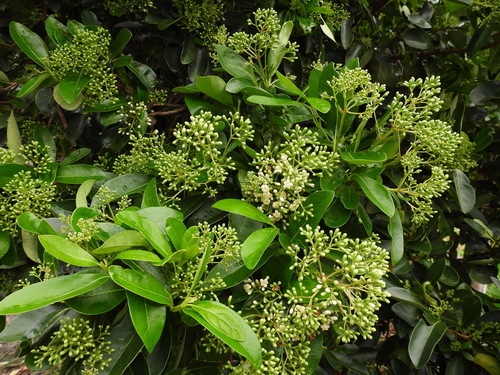
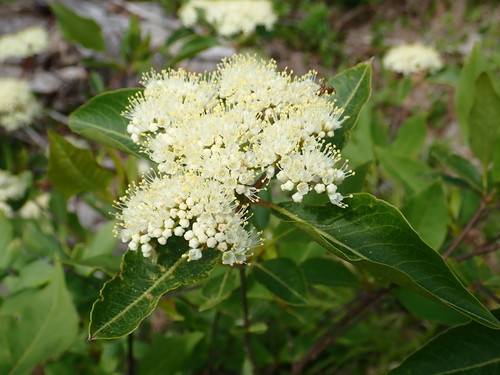
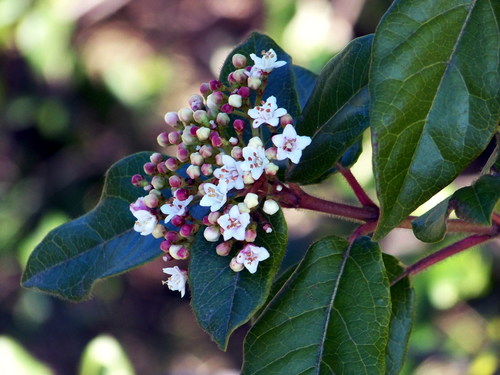
Viburnum tinus L. is most often a dense, rounded-crowned shrub, and rarely grows as a small tree. It reaches 2–7 m (7–23 ft) tall and up to 3 m (10 ft) broad. Its evergreen leaves persist for 2–3 years; they are ovate to elliptic, grow in opposite pairs, measure 4–10 cm long and 2–4 cm broad, have fine hairs that remain on the underside, and have smooth entire margins. Small flowers grow from reddish-pink buds, in dense 5–10 cm diameter cymes that open during winter. These fragrant flowers are bisexual, with the species being monoecious (all plants bear both male and female flower parts) and pentamerous. Some people find the fragrance unpleasant, especially after rain when the scent becomes very strong. In the northern hemisphere, flowering runs from October through June. The five petals form a tubular base with rounded corolla lobes; petals are pink when in bud, and turn white after opening. Flowers have a single whorl of five stamens. Insects act as pollinators for this species. It produces a dark blue-black drupe fruit 5–7 mm long. A 2020 study found the fruit’s distinctive metallic blue color comes from microscopic fat globules, a rare example of structural color in plants. The leaves have domatia that provide shelter for predatory and microbivorous mites. This species is native to the Mediterranean region, where it prefers shady, moist locations. It is most common in the western Mediterranean thanks to the region’s shorter drought season, and it is one of the dominant species of Mediterranean sclerophyllous shrubland. It has been introduced to Australia, New Zealand, Pakistan, California, Oregon, and Tajikistan. Viburnum tinus is widely cultivated as a garden plant, valued for its winter flowers and metallic blue berries. It is cold hardy down to −10 °C (14 °F). Three of its cultivars—'Eve Price', 'French White', and 'Gwenllian'—have earned the Royal Horticultural Society's Award of Garden Merit. It has been used for traditional medicinal purposes, for example in Pakistan. Its known active components are viburnin (most likely a mixture of multiple compounds, rather than a single substance) and tannins; tannins from the plant can cause stomach upset. An infusion of the leaves is reported to have antipyretic properties. The fruits have been used as a purgative to treat constipation. More recently, its tincture has been used in herbal medicine as a treatment for depression. The plant also contains iridoid glucosides.