About Viburnum rufidulum Raf.
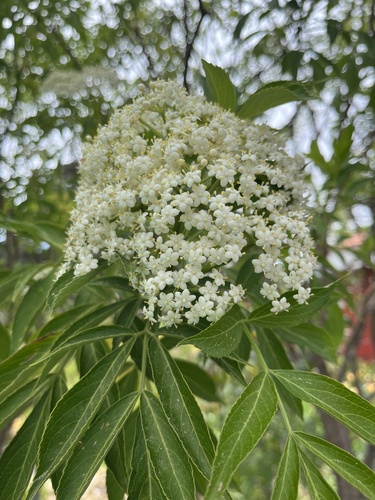
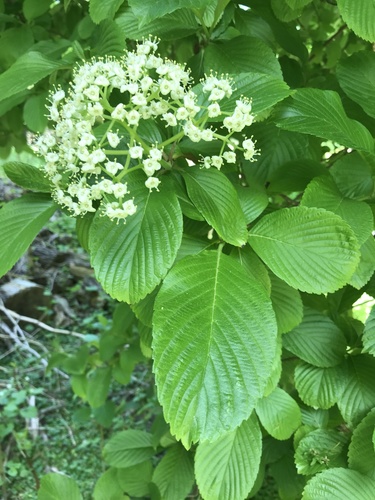
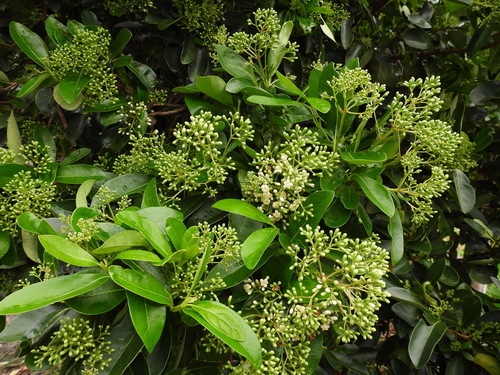
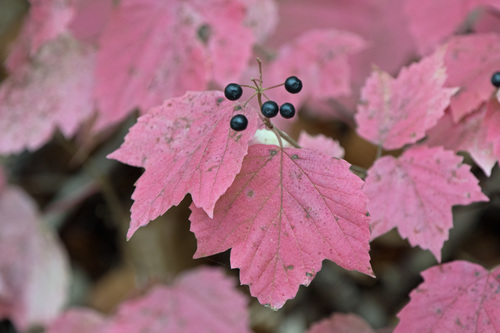
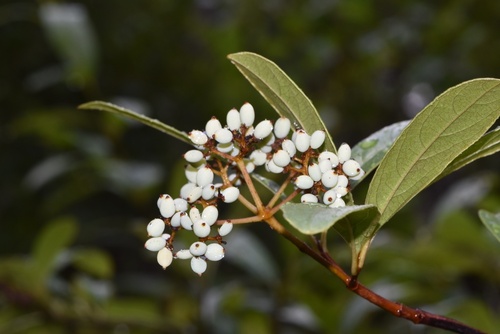
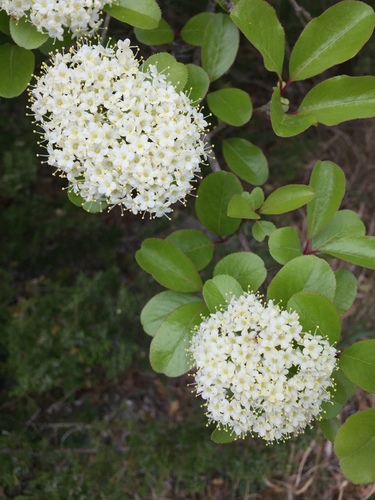
This species is scientifically named Viburnum rufidulum Raf., commonly known as rusty blackhaw. It has leathery deciduous simple leaves that grow in opposite arrangements; leaf blades range from 0.5 to 3 inches long and 1 to 1.5 inches wide. Its petioles are "rusty hairy," grooved, and sometimes have wings, and leaf margins are serrate. Autumn foliage takes on bronze to red coloring. Twigs are colored reddish brown to gray; young twigs are hairy, becoming smoother as they age. Its bark is similar to that of flowering dogwood, ranging in color from reddish brown to almost black, and forms blocky plates on larger trunks. V. rufidulum blooms from April to May, producing creamy white bisexual (perfect) flowers that resemble flowers of other Viburnum species, held in clusters that can reach up to six inches wide. Its fruits are purple or dark blue, glaucous, globose or ellipsoid drupes that mature in mid to late summer. The edible fruit is reported to taste like raisins, and it attracts birds. This species is similar to Viburnum prunifolium (blackhaw), but V. prunifolium petioles lack the characteristic rusty hairs found on V. rufidulum petioles. Rusty blackhaw prefers dry habitats, generally at elevations below 750 m. It grows in the U.S. states of Alabama, Arkansas, Florida, Georgia, Illinois, Indiana, Kansas, Kentucky, Louisiana, Mississippi, Missouri, North Carolina, Ohio, Oklahoma, South Carolina, Tennessee, Texas, Virginia, and West Virginia. V. rufidulum often grows in loamy sand, and individuals have been observed in upland woods, deciduous woods, and palm hammocks. It is occasionally used as an ornamental plant.