About Viburnum opulus L.
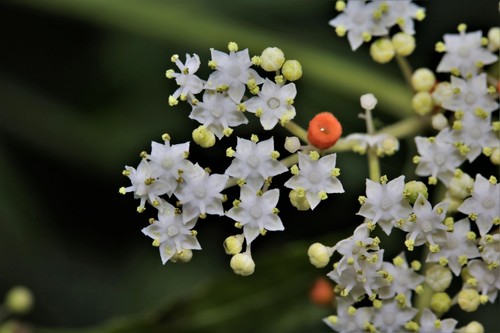
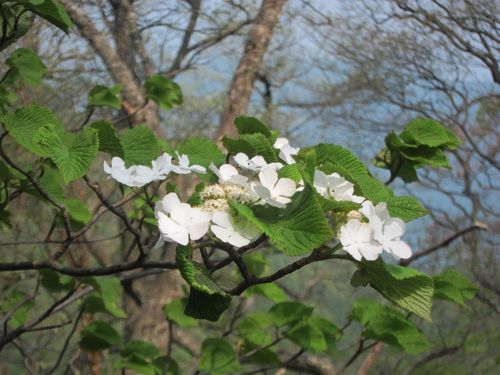
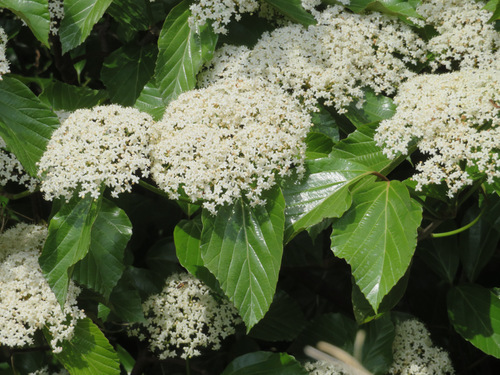
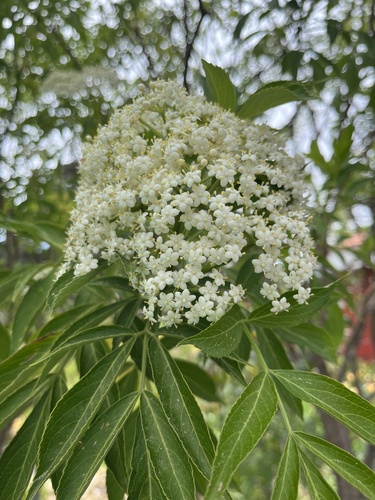
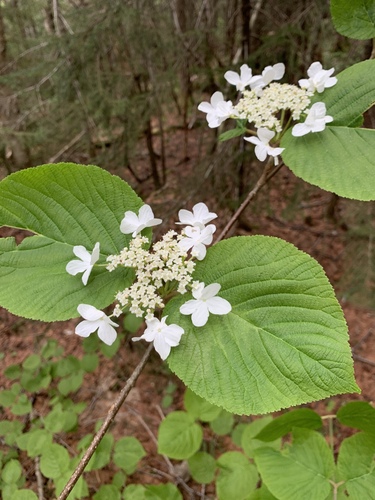
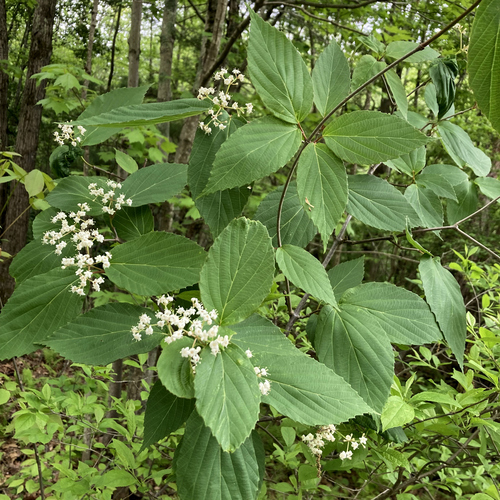
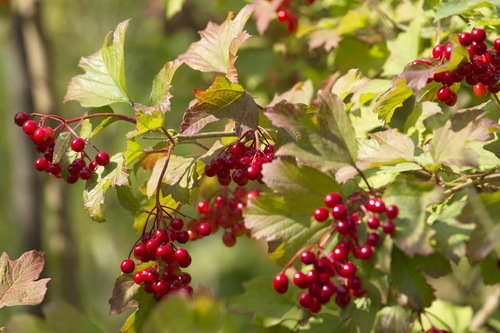
Viburnum opulus L. is a deciduous shrub that reaches a height of 4–5 m (13–16 ft). Its leaves are arranged oppositely, are three-lobed, and measure 5–10 cm (2–4 in) in both length and width, with a rounded base and coarsely serrated edges. Superficially, these leaves resemble the leaves of some maple species, but can be easily distinguished by their somewhat wrinkled surface with indented leaf venation. Leaf buds are green, with valvate bud scales. This species produces hermaphrodite white flowers that are borne in corymbs 4–11 cm (2–4 in) in diameter at the tips of stems. Each corymb has a ring of outer sterile flowers 1.5–2 cm (5⁄8–3⁄4 in) across with noticeable petals, which surround a cluster of small fertile flowers that are 5 mm (1⁄4 in) across. Flowering occurs in early summer, and the flowers are pollinated by insects. The fruit is a globose, bright red drupe that is 7–10 mm (1⁄4–3⁄8 in) in diameter, holding a single seed. Seeds are dispersed by birds. On average, fruits persist for 200 days, and every fruit contains exactly one seed. Fruits are on average 88.0% water by content; their dry weight is made up of 17.3% carbohydrates and 1.3% lipids.
The species is native to Europe, northern Africa, and central Asia, and has become naturalised in North America.
The fruit is edible when eaten in small quantities, and has a very bitter taste; it can be used to make jelly. However, the fruit is mildly toxic, and eating large amounts may cause vomiting or diarrhea. Ripe fruit is often left uneaten by birds and avoided by humans, because crushing it releases a foul smell that has been described as similar to 'musty socks' or 'urine and vomit'. The common name 'cramp bark' refers to the bark's traditional medicinal use to treat cramps, but there is no scientific evidence supporting that it is effective for this purpose or any other.
Viburnum opulus is grown as an ornamental plant valued for its flowers and berries. It grows best on moist, moderately alkaline soils, though it tolerates most soil types well. Multiple cultivars have been selected, including 'Roseum', where all flowers are the larger sterile type, forming globular flower heads. In its native regions, the shrub is also grown as a component of hedgerows, cover plantings, and other naturalistic planting schemes. The cultivars 'Notcutt's Variety', 'Roseum', and the yellow-fruited 'Xanthocarpum' have been awarded the Royal Horticultural Society's Award of Garden Merit.