About Viburnum edule (Michx.) Raf.
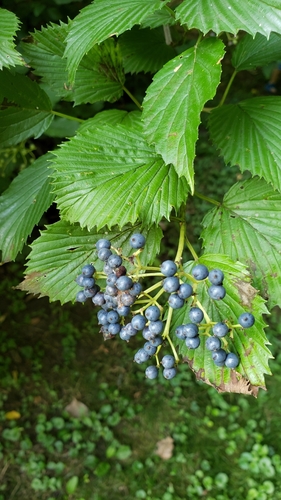
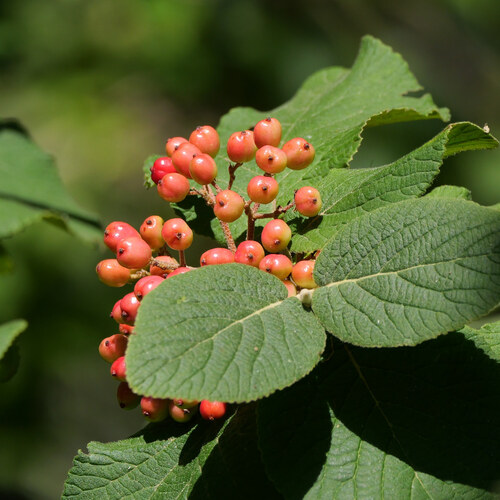
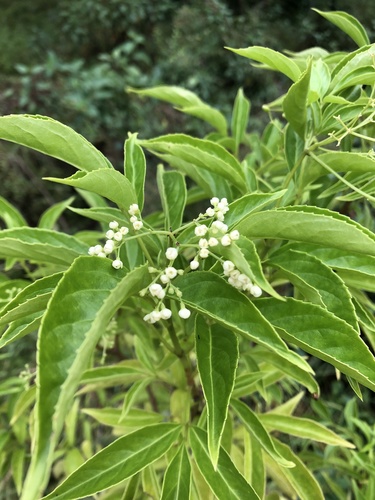
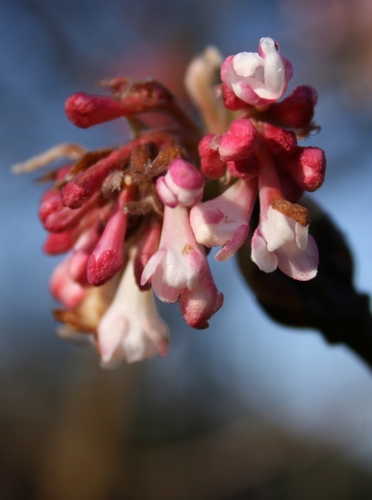
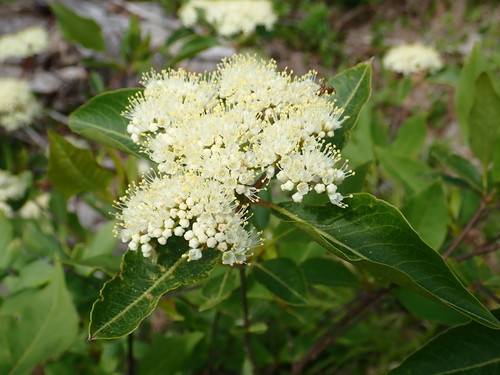
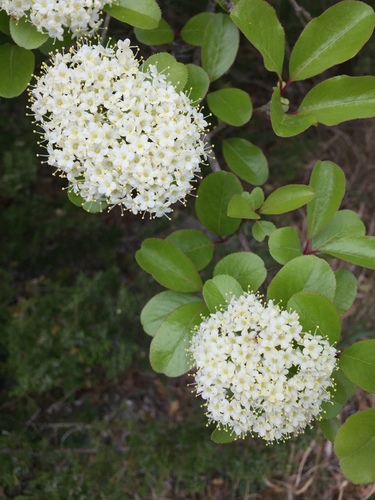
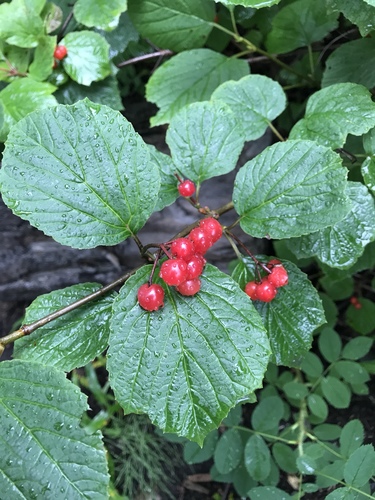
Viburnum edule (Michx.) Raf., commonly called squashberry, is a deciduous dicot shrub that grows 0.5–2.5 metres (1+1⁄2–8 ft) tall. It has smooth, reddish-grey bark and glabrous twigs. Its leaves are arranged oppositely, elliptic in shape, 6–10 centimetres (2+1⁄4–4 in) long, and may be unlobed or shallowly 3-lobed with jagged serrated edges. The leaves turn red in autumn, and their undersides are glabrous, especially along the veins. Its flowers form small, compact inflorescences 1–3 cm (1⁄2–1+1⁄4 in) across that are either flat or rounded, and hold several flowers. All flowers are synoecious and fertile, with white petals fused at the base to form a tube that flares out into five lobes at the top. The stamens are short, measuring 1 mm or less, and remain hidden inside the corolla. The fruit, which ripens early in spring, is an edible red or orange berry-like drupe 0.8–1.5 cm (1⁄4–1⁄2 in) long, borne in clusters, with each fruit holding a single flattened stone. Squashberry is distributed across Canada, throughout Alaska, and in the northern United States. It is abundant from Yukon, northern Quebec, and western District of Mackenzie east to James Bay, and south from Newfoundland to Oregon, Idaho, Colorado, Minnesota, and Pennsylvania. It grows as a dominant or codominant understory plant in coniferous forests, and often grows abundantly in Picea glauca (white spruce) forests. It is an important pioneer species that colonizes areas early after forest fires. It can be found growing in moist soils across a variety of forested regions, and also occurs in dense stands of trees and shrubs, along wetlands and bodies of water, and at higher elevations on gravel banks. It grows best in moist alluvial soil with good drainage. The plant's seeds are dispersed by birds and mammals, which carry, eat, digest, and excrete the seeds in new locations. In ecological terms, many species of birds and mammals eat the wild berries of this shrub, and smaller animals use the plant for shelter. When the seeds are removed, the fruit is commonly eaten fresh, and can also be used to make jams and jellies. Multiple parts of the plant have been used in herbal medicine: berries are used to prepare herbal cough medicines, roots are made into tea to relieve tooth pain and sore throats, twigs can be chewed or used to make a gargle tea for sore throats, and closed flower buds are massaged on the lips to treat lip sores. Modern research has found that the fruit contains high levels of antioxidants. Numerous Indigenous peoples have traditionally used this plant. The Nuxalk people of the Bella Coola region of British Columbia use the berries for food, as the plant grows quickly and produces high quantities of berries; a single Viburnum edule shrub can produce up to 100 berries. Multiple First Nations groups on the northwestern coast of North America have cultivated Viburnum edule by planting it in wild forest gardens. Consumption of the berries appears in multiple origin myths of the Haida people, where the berries are often depicted as food eaten at feasts or by supernatural beings. Inuit peoples near the Nain settlement in Newfoundland and Labrador also traditionally collect the wild fruits of this plant.