About Viburnum dilatatum Thunb.
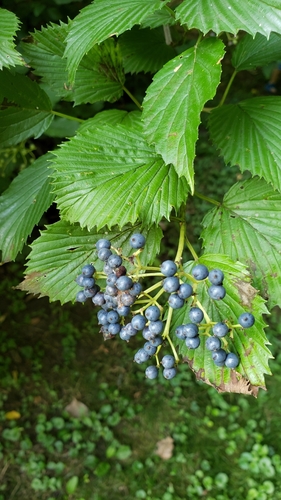
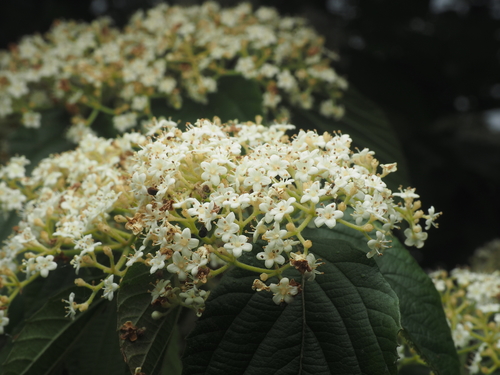
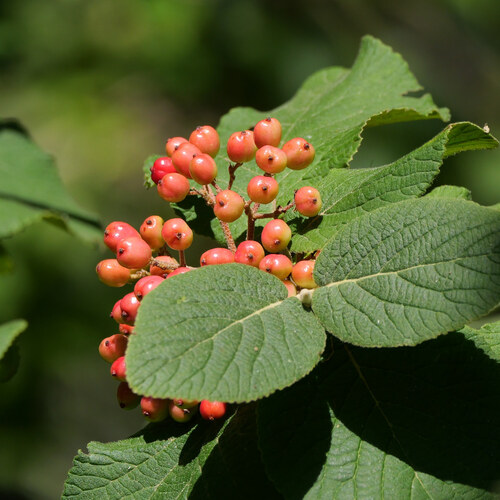
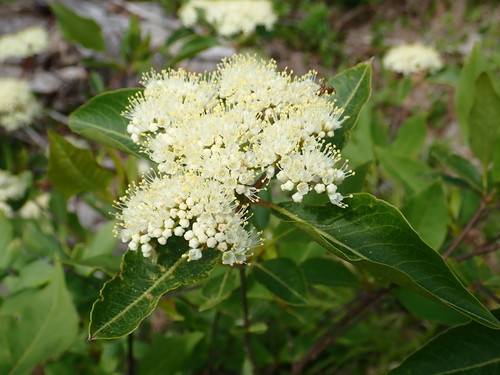
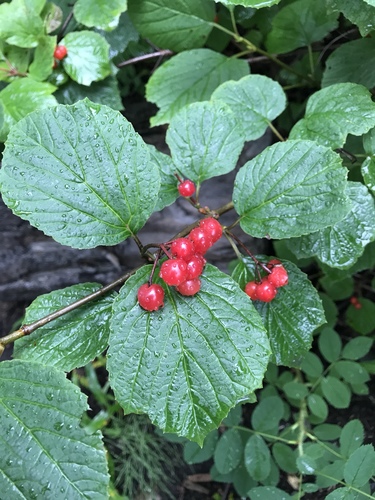
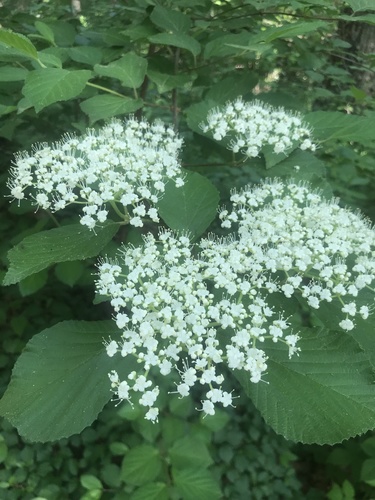
Viburnum dilatatum Thunb., commonly known as linden arrowwood or linden viburnum, is a deciduous shrub that can grow up to 3 meters tall and wide. Young stems have brown bark with orange tones, are pubescent (covered in fine short hairs), and mature to a dark gray color as they age. Its leaves are simple, arranged oppositely on branches, and vary in shape from broadly obovate, obovate, to broadly ovate. Individual leaves measure between 5.1–13 centimeters (2.0–5.1 inches) long and 2.5–6.4 centimeters (0.98–2.52 inches) wide. Leaves have shallowly toothed margins, are usually pubescent, and are deciduous, dropping in late autumn. Foliage changes color with the seasons: it is dark green in summer, and turns from bronze to burgundy in autumn. Flowers bloom after leaves emerge, forming small clusters of creamy white blooms from May to early June. Each flower is perfect, meaning it contains both male stamens and female styles. The fruit is a round, red, glabrous (hairless) fleshy drupe that grows in clusters similar to the flowers. Fruits stay red from September to early December, and individual berries measure 0.84 centimeters (0.33 inches) in diameter. In Japan, these berries are called gamazumi.
In its native range of China, Japan, and Korea, linden arrowwood grows in lowlands, open forests, and scrubby areas. It grows best in moist soil and sunny locations. It was introduced to the United States as an ornamental plant in the early 1800s, and has only spread locally, with populations concentrated in the Mid-Atlantic region. It has been reported as an invasive species in some US states where it occurs.
Animal dispersal is the primary means of spread for this species: the bright red berries attract birds, which eat the berries and deposit the seeds in new areas. As an invasive species in the United States, it is considered a threat to native plant species, because its foliage creates shade that limits sunlight reaching nearby native plants. It also gains a competitive advantage from leafing out early in spring and retaining leaves late into autumn. To reduce reproduction of this species, recommended control measures include pulling small plants under 0.91 meters (3 feet) tall out of the ground; for taller plants, cut stems to ground level before fruiting, then spray with herbicide to stop regrowth. Seed heads from mature plants should be removed to prevent seed dispersal.
This species is used as an ornamental plant, often planted in mass groupings for its attractive clusters of white flowers. However, due to its invasive tendencies, planting this species is strongly discouraged in some US states, particularly in the Mid-Atlantic region. In traditional Chinese medicine, the berries, leaves, and stems are used to make a soup to treat snake bites, dysentery, and to use as a vermifuge.
For cultivation, best results are achieved when linden arrowwood is grown in moist, fertile, slightly acidic to neutral soil. It requires full sun, but will also grow well in shaded areas and warm climates. It transplants easily and establishes well. It can be propagated from cuttings; seeds require a chilling period to germinate. Planting multiple shrubs close to one another increases fruit production. There have been no reports of this species being harmful to fauna in the United States.