About Vespula pensylvanica (de Saussure, 1857)
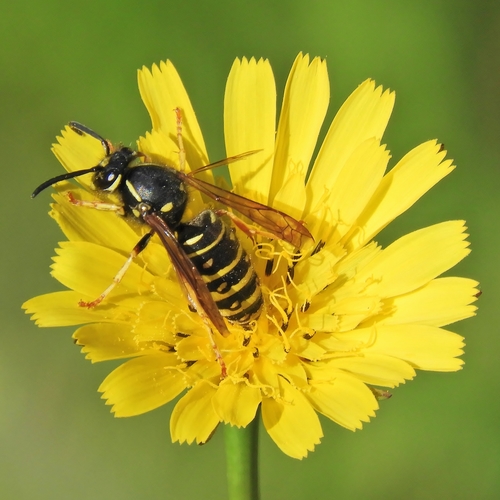
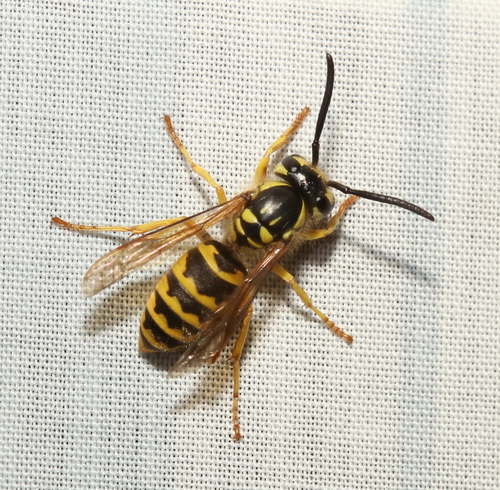
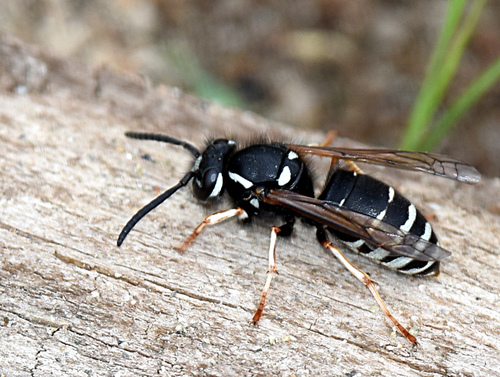
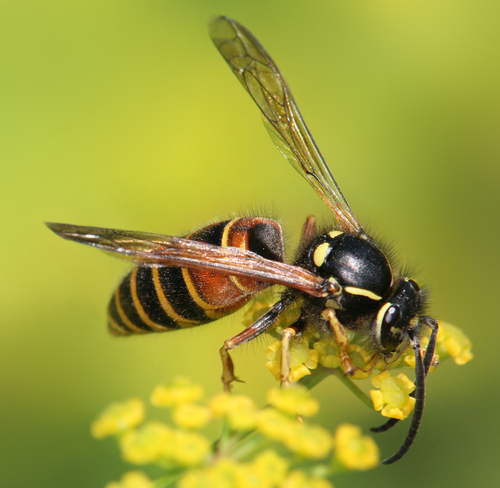
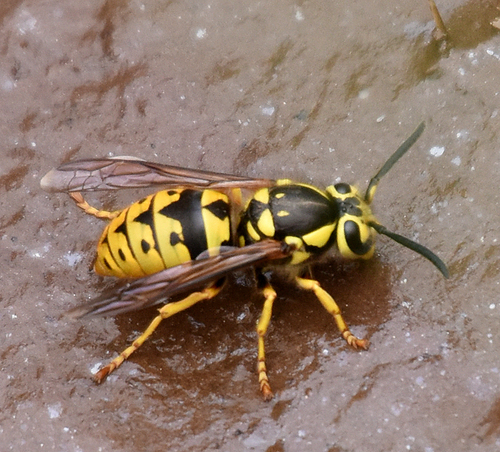
Vespula pensylvanica, commonly known as the western yellowjacket, shares the characteristic yellow and black body pattern of other social wasps in the genus Vespula. This similarity means it is often misidentified, and it closely resembles Vespula germanica in particular. While both species have a similar diamond-shaped black mark on the first tergum, V. pensylvanica can usually be distinguished by a continuous yellow ring, called an eye-loop, around each eye. This eye-loop is not always present, however: few females lack this marking, but males often do not have the eye-loop at all. When the eye-loop is absent, V. pensylvanica can be identified by a spotted mark on the frons below the antenna, a slender aedeagus, and a denser apical region on the seventh tergum. Fore wing length varies by caste and sex: it measures 8.5–10.5 mm for workers, 12.5–14.5 mm for females, and 12.5–14.0 mm for males. Western yellowjackets build large nests from wood fibers. The nest is enclosed in a hexagonal paper envelope, with a small 10 to 30 cm entrance tunnel at the bottom. Nests are typically located 10–15 cm below ground, or in other dark enclosed spaces like rodent burrows. The western yellowjacket is native to the western half of North America, where it lives in temperate zone climates. Its native range overlaps with the range of Vespula atropilosa. It has been recorded in the Canadian and Transition Zones of western North America, and occurs in all states west of the Rocky Mountains, spanning from Mexico through western Canada. It has also been introduced to Hawaii, where it is found on the islands of Kauai, Oahu, Maui, and Hawaii. This species inhabits open forest, prairies, urban areas, gardens, parkland, meadows, and houses.