About Vespa mandarinia Smith, 1852
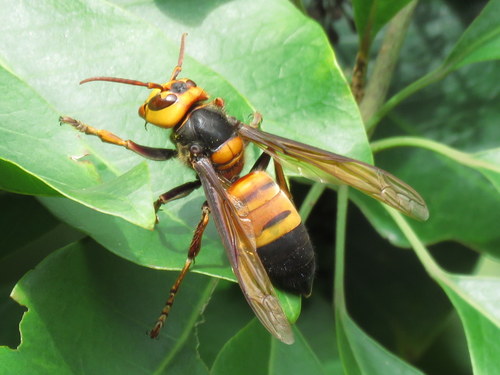
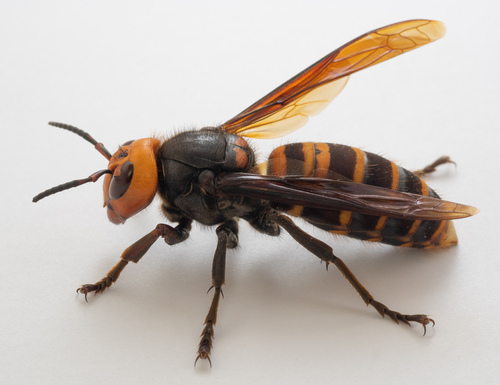
Regardless of sex, the head of Vespa mandarinia Smith, 1852 is a light orange shade, and its antennae are brown with a yellow-orange base. Its eyes and ocelli range from dark brown to black. This species can be distinguished from other hornets by its prominent clypeus and large genae. Its orange mandible holds a black tooth that the hornet uses for digging. The thorax is dark brown, and it has two grey wings with a span that ranges from 35 to 76 mm (1+3⁄8 to 3 inches). The hornet's forelegs are a lighter color than its midlegs and hindlegs, and the base of the forelegs is darker than the rest of the leg. The abdomen has alternating bands of dark brown or black and yellow-orange, a hue that matches the color of the hornet's head. The sixth abdominal segment is yellow. The stinger of V. mandarinia is typically 6 mm (1⁄4 inch) long, and it delivers potent venom that can kill a human if a person is stung by multiple hornets at the same time, or in rare cases of allergic reaction. V. mandarinia lives primarily in forests. When it occurs in urban landscapes, it is strongly associated with green spaces. Among all Vespa species, V. mandarinia is the most dependent on green space, while V. analis is the least dependent. Extremely urbanized areas act as a refuge for V. analis, while V. mandarinia, which is a predator of V. analis, is completely absent from these areas. V. mandarinia is not exclusively carnivorous, and also acts as a pollinator. It is one of the diurnal pollinators of the obligate plant parasite Mitrastemon yamamotoi. It is also among the most common pollinators of Musella lasiocarpa in Yunnan Province, China. For mass control of V. mandarinia at apiaries, hornets are captured and fed either a sugar solution or a bee that has been poisoned with malathion. The toxin is expected to spread through the colony via trophallaxis. This method is sound in principle, but has not been extensively tested.