About Vespa affinis (Linnaeus, 1764)
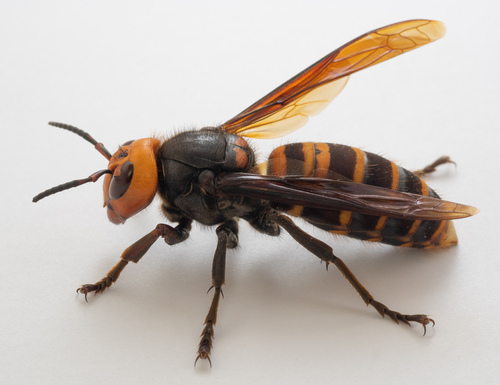
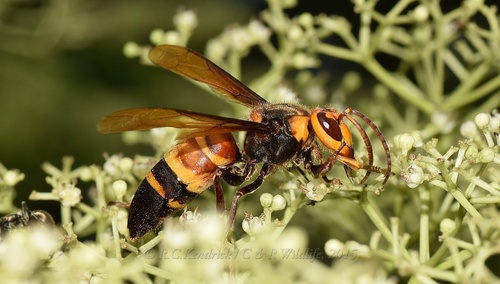
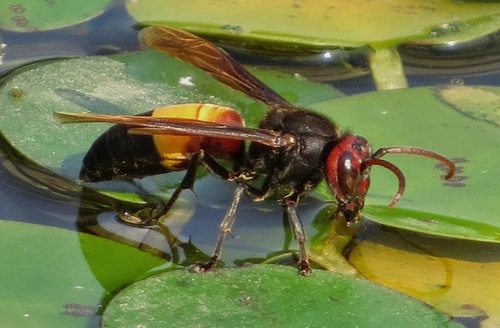
Vespa affinis, commonly called the lesser banded hornet, is a small to medium-sized hornet. Queens grow up to 30 mm long, males reach 26 mm, and workers average 22 to 25 mm in length. Its head is brownish red or black and covered in fine hairs, with red markings on the frons and vertex and a black temple. The compound eyes and ocelli are black, the antennae are dark brown and usually pale brown on their underside. The clypeus is black, coarsely punctate, and has broadly rounded lobes on its posterior side; the mandibles and teeth are black. The thorax is black with many punctures and some erect hairs, and the propodeum is also black. The legs are dark brown, the wings are dark fuscous brown, and the tegulae are dark brown. The gaster has fine punctures, and most segments are dark brown, except the first and second segments which are yellowish orange. In some specimens, the yellowish orange marking on the first tergite may be reduced to two transverse spots and a narrow apical band. This species has many color variants across its distribution range. These variants were originally classified as separate subspecies, but are no longer recognized as such. While there has been a long history of recognizing subspecies within many hornets of the genus Vespa, the most recent taxonomic revision of the genus treats all subspecific names in the genus Vespa as synonyms, leaving these variants only as informal names for regional color forms. In Hong Kong and South China, these hornets are mainly black, with deep yellow coloration on the first two abdominal segments that forms a conspicuous band, and some reddish brown coloring on the sides of the head and thorax. In Southeast Asian regions such as Singapore, the hornets are fully black with no reddish brown markings, and their abdominal band is a brilliant orange. The lesser banded hornet is widespread throughout tropical and subtropical Asia. It has been recorded in Sri Lanka, Hong Kong, Taiwan, Burma, Thailand, Laos, Vietnam, Cambodia, Indonesia, the Philippines (Palawan), Singapore and Malaysia. In the subtropical climate of Hong Kong, queens emerge from hibernation in April, and the entire colony usually dies in late November or December. In tropical areas, the lesser banded hornet is present year-round. In tropical regions, this species is known for pleometrosis, also called multiple queen founding or swarm founding, where new colonies are started together by several queens, or multiple queens accompanied by a swarm of workers from an old nest.