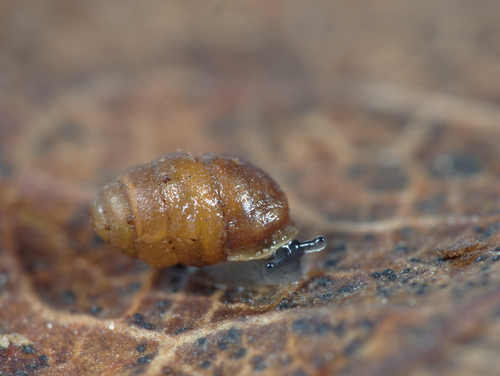
About Vertigo pygmaea (Draparnaud, 1801)
Vertigo pygmaea (Draparnaud, 1801) has two documented shell descriptions. In the first description (published under the name Vertigo heldi), the shell is extremely small, oval-cylindric, obtuse at the summit, with a more or less deep brown color, and is smooth and dull. The spire is made up of five whorls. The aperture is scarcely longer than wide, nearly round, and has four teeth: an acute superior tooth, two deeply placed inferior teeth, and one tooth on the columellar margin. A fifth tooth is often present at the base of the aperture. The lateral margin is slightly angular in the middle, the peristome is reflected below, and the umbilical crevice is quite pronounced. In the second description (also as Vertigo heldi), the shell is rimate, turreted, irregularly and very finely striate, reddish-brown, and glossy. It has six whorls that increase slowly and are rather convex. The first three whorls form a blunt summit that makes up about one-third of the shell’s total length, while the last three whorls are nearly equal in height and form the remaining cylindrical part of the shell. The last whorl is neither calloused nor contracted before the aperture. The aperture makes up about one-quarter of the shell’s length, is arcuately convex, somewhat impressed on the outer side, with the impression extending a short distance as a groove-like depression on the last whorl. The aperture is toothed, with reddish, very weak teeth placed deep in the throat: one tooth on the middle of the parietal wall, one on the columella, and two very weakly developed teeth that are frequently absent on the palatal wall. The peristome is continuous, somewhat expanded, and only slightly thickened. Adult shells measure 1.1-1.25 mm in width and 2.4-2.7 mm in height. This snail lives under hedges. This species occurs in Europe, including in the Czech Republic, Netherlands, Poland, Slovakia, Ukraine, Great Britain, Ireland, Latvia, and other areas. It is also found across various locations in America, including Michigan where it is listed as a special concern species; it can be found in the List of threatened fauna of Michigan.

