About Verseghya thysanophora (R.C.Harris) S.Y.Kondr., Lőkös, Farkas & Hur
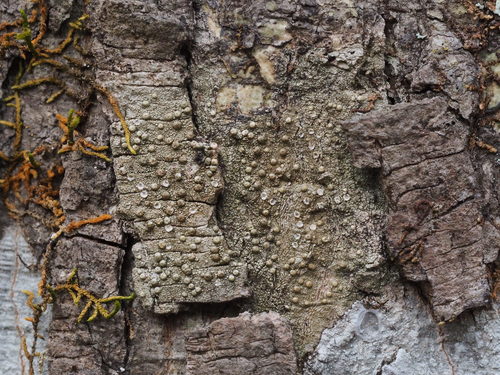
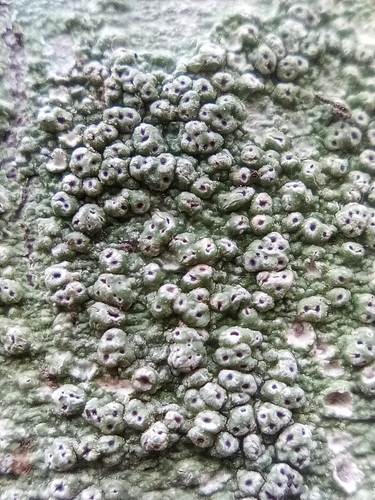
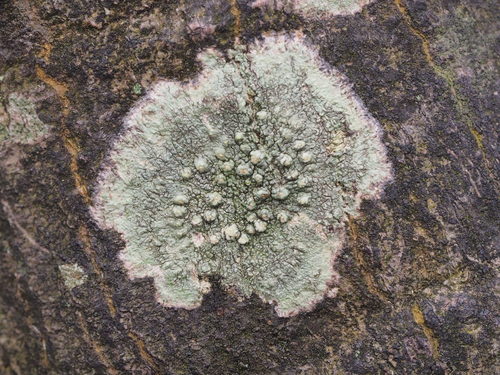
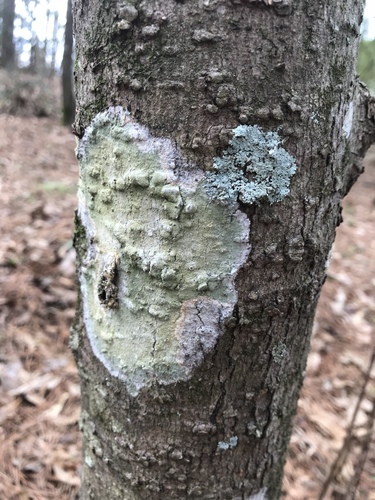
Verseghya thysanophora ranges in color from pale yellow to greenish, and may show blue or grey tones when growing in shaded areas. It has a thin, leprose texture, and sometimes grows in distinct patches. A visible, white fibrous prothallus is often present, with hyphae organized into distinct radiating strands. Its soralia can be either discrete, or merged to form a continuous crust. This lichen hosts a trebouxioid green algal photobiont, with cells measuring 8–12 μm in diameter. Apothecia, the reproductive structures of this lichen, are rarely observed, but can occur in abundance in some cases. The apothecia are colored pale yellowish brown to greyish brown, with raised margins that are distinctly yellow or whitish, creating a visual contrast with the color of the thallus. Asci are of the Lecanora-type, containing eight spores each, measure up to 90 by 20 μm, have a distinct tholus, and lack an ocular chamber. The ascospores are non-septate, hyaline, ellipsoid, and measure 11–14 by 6–9 μm. Verseghya thysanophora contains a group of unidentified terpenoids referred to as "thysanophora unknowns." These compounds can be detected via thin-layer chromatography, and appear ice blue under long-wavelength UV light after charring. The lichen also contains atranorin, usnic acid, and zeorin; porphyrilic acid is detected in approximately one quarter of all collected specimens. Verseghya thysanophora most commonly grows on the trunks of deciduous trees, particularly Acer saccharum and Thuja occidentalis, and occasionally grows on shaded siliceous rocks. It typically occurs in mature maple forests, and is most often fertile on trees growing near streams. It is widespread across the East Temperate region of North America. In Europe, it has been recorded in Austria, Belarus, Bulgaria, Germany, Poland, and Slovenia. It was reported from Jinzhai County, China in 2011, and from Santana do Livramento, Brazil in South America in 2015.