About Veronicastrum virginicum (L.) Farw.
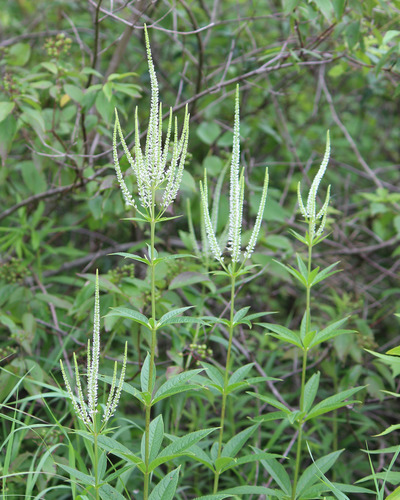
Veronicastrum virginicum (L.) Farw. has hairless, usually unbranched stems. Its leaves are serrated and arranged in whorls of 3 to 7 around the stem. The inflorescence is upright, consisting of slender, spike-shaped racemes that reach about 9 inches (23 cm) long, which gives the entire flower cluster a candelabra-like shape. The crowded stamens stick out in a brush-like pattern perpendicular to the raceme. The corollas are white and roughly 2 millimeters in length. These plants flower for approximately one month, from mid-June to late August, with timing varying based on latitude.
The distribution of Veronicastrum virginicum extends from southern Maine to northwest Florida, west to northern Louisiana, north through Minnesota, and reaches somewhat north of the Canada–United States border. Commonly called Culver's root, this species is often found in wet to wet-mesic prairies, and sometimes grows in moist upland sites. It also occurs in a large number of restored prairies or native meadows.
The larvae of the Culver's root borer moth feed on this plant.
Veronicastrum virginicum is grown as an ornamental plant for temperate gardens within its native range in the Eastern and Central United States. Most native plant nurseries regularly sell this easy-to-grow, adaptable perennial. It is also sold by some conventional nurseries, though it is not yet commonly used in American landscapes and gardens. It is fully hardy to at least −20 °C (−4 °F). It grows in full sun to part shade, and tolerates any moist, well-drained soil. Like many common perennials, it is easy to dig up, divide, and replant when clumps become too large or crowded. It grows as an upright clump and does not spread far. Plants rarely need staking, but older clumps may require this support. The plant can be pruned down in late May, or dug up, divided, and replanted to manage size. It produces tiny seeds and does self-sow to some extent. In the United Kingdom, the cultivars 'Album' with white flowers, and 'Lavendelturm' with lilac flowers, have received the Royal Horticultural Society's Award of Garden Merit.