About Veronica triphyllos L.
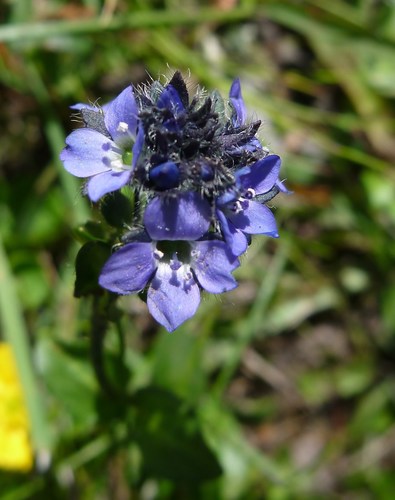
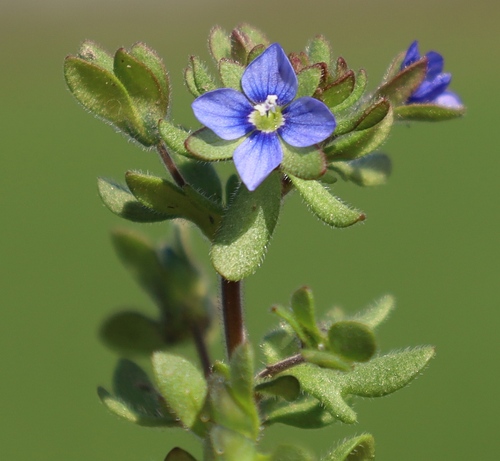
Veronica triphyllos L. is a small annual glandular-hairy herb that reaches up to 20 cm tall. It bears small paired leaves, growing to a maximum size of 12 mm by 8 mm, that are deeply lobed. The lobes all extend down to a small area at the base of the leaf, arranged like fingers on a hand. Small deep blue flowers grow on moderately long stalks 5–15 mm in length at the tops of stems; these flowers measure 3–4 mm in diameter, and can reach up to 10 mm across. After maturing, flowers produce a fruit 5–6 mm long. The seeds of Veronica triphyllos are bowl-shaped. Photographic examples of this species can be viewed on iNaturalist. This species is similar to Veronica verna, which can be distinguished by its leaf lobes that extend along the full length of the leaf, short flower stalks that measure 1–3 mm, and flat convex seed faces. Veronica triphyllos is native to Europe and western Asia, and has been introduced to the United States. Within its native range, it occurs in Albania, Algeria, Austria, the Baltic States, Belarus, Belgium, Bulgaria, Cyprus, Denmark, France, Germany, Greece, Hungary, Iran, Iraq, Italy, Kazakhstan, Crete, Crimea, Lebanon-Syria, Morocco, Netherlands, North Caucasus, Poland, Portugal, Romania, South European Russia, Spain, Sweden, Switzerland, Transcaucasus, Turkey, Ukraine, Uzbekistan, and Yugoslavia, and is doubtfully recorded from Sicily. It has been introduced to California, Czechoslovakia, Great Britain, Idaho, Kansas, Missouri, New York, Oklahoma, Oregon and Washington. In Europe, its typical habitats are dry grassland, cultivated ground and waste places. In Turkey, it grows at 100–2000 m elevation in Pinus forests, stony pastures, rocky hills, banks, sandy fields, gardens and roadsides.