About Veronica strictissima (Kirk) Garn.-Jones
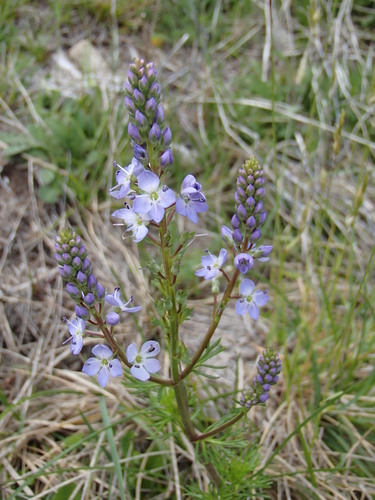
Veronica strictissima (Kirk) Garn.-Jones grows as a rounded shrub reaching up to 2 meters (6 feet 7 inches) in height. Its specific epithet, strictissima, refers to the species' erect stems. The leaves are arranged oppositely, are narrowly oblong in shape, and measure 9–49 mm (0.35–1.93 in) long by 3–8 mm (0.12–0.31 in) wide. Foliage is light green, with leaf undersides that are slightly paler than the upper surface. Inflorescences take the form of racemes that grow 17–107 mm (0.67–4.21 in) long. Individual plants produce either all hermaphrodite flowers or all female flowers. Seed capsules hold multiple tiny seeds; the seeds themselves are flat, brown, and 1.0–1.6 mm (0.04–0.06 in) long. Veronica strictissima is endemic to Banks Peninsula, Canterbury, New Zealand, where multiple distinct separate populations have been recorded. It is an early coloniser of disturbed habitats, growing in sunny, open areas including rocky outcrops, cliffs, scrubland, and roadside banks, from sea level up to 853 m (2,800 ft). Unlike the predominantly alluvial soils of lower Canterbury, Banks Peninsula has a different soil composition, made up of loess over basalt rock. This species prefers moderately moist, low-salinity soils with good drainage. Flowering occurs in summer, sometimes extending into early autumn. Individual plants flower for 2–5 weeks, and flowers on a single plant's raceme typically bloom at the same time. Flowers are pollinated by Lasioglossum sordidum, a single species of bee native to New Zealand. Seed capsules develop in autumn and split open to release seeds in late autumn. Seeds are primarily dispersed by wind, but can also be spread by birds and lizards. Veronica strictissima is grazed by sheep, goats, and cows. Its nectar and fruit are eaten by lizards and birds. It and other species in the genus Veronica are fed on by moths of the genus Platyptilia, and by the species Xyridacma veronicae. During World War II, Veronica strictissima was used to treat dysentery. Māori traditionally used this plant as medicine to treat ulcers, headaches, and kidney and bladder problems.