About Veronica serpyllifolia L.
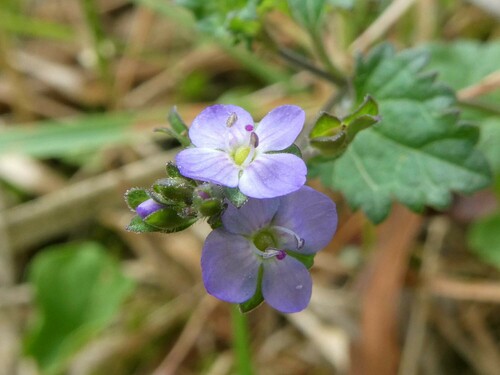
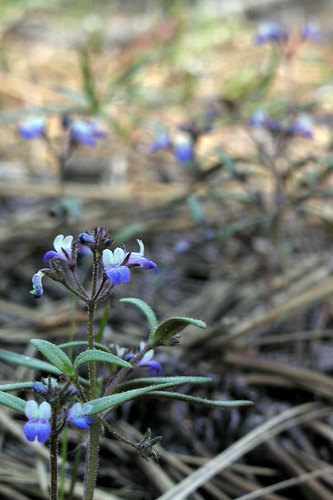
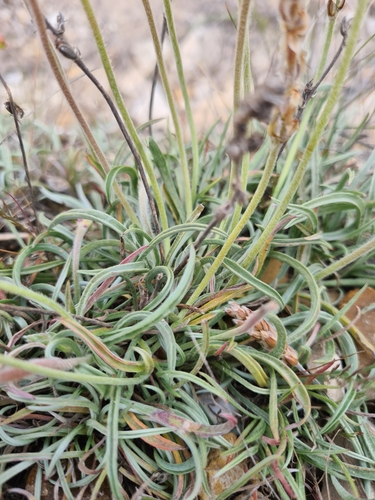
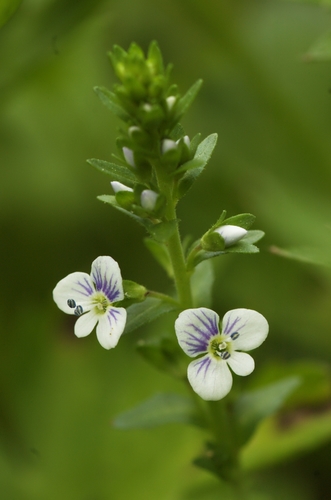
Veronica serpyllifolia L. starts growing low to the ground before developing upright growth. It has creeping stems that hold oval leaves, and roots grow from the plant's leaf axils. The prostrate stems produce erect flowering branches that reach up to 20 cm high. Leaves grow opposite each other on short stalks, and flowers are arranged in racemes, with a corolla 6 mm wide. Seedling first leaves lack petioles, are hairless, and have smooth margins. Stems grow from nodes on the plant's rhizomes, which lets it form thick mats close to the ground. Lower leaves are oval with smooth margins; upper leaves are also oval but smaller than lower leaves. Lower leaves have relatively short stalks, while upper leaves are stalkless, with no petioles. Flowers have four petals and grow from leaf axils. Fruits are capsules that are obcordate (heart-shaped), mostly flattened, with a hairy outer layer and a notched tip. These capsules measure approximately 2.5–3.5 mm long. When mature, capsules open to release many small seeds; the inside of the fruit capsule is lined with hairs, and the seeds inside are also flattened. The plant has a root system that is both fibrous and rhizomatous. It can be hard to spot, because it is relatively small and grows in patches that are often covered by grass, and it is more noticeable when it is in bloom. This species reproduces either by releasing its seeds, or via stems that root directly into the ground. The variety Veronica serpyllifolia L. var. serpyllifolia, commonly called thyme-leaved speedwell, is native primarily to Eurasia, and has been introduced to North America and New Zealand. As of 2010, this variety has been recorded in 37 US states, and is classified as a weed in North America. It grows most often in open grasslands and cultivated areas on lighter soils. It grows in full sunlight, tolerates partial shade, and thrives in moist conditions during the spring. It can grow at elevations up to 3300 m. Pollinators that visit Veronica serpyllifolia flowers for nectar include flies and bees. Seeds can be dispersed by sticking to the wings of birds or the fur of some animals. Seeds of this species have been found in cattle dung, so cattle and other grazing animals are likely important seed dispersers for this plant.