About Veronica agrestis L.
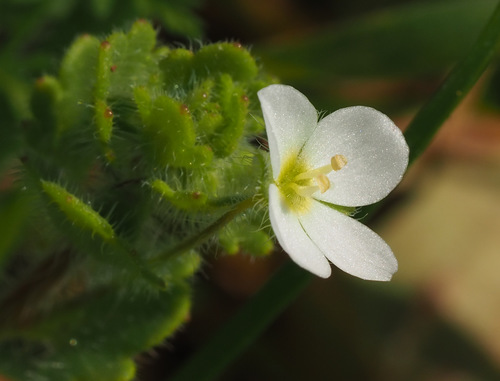
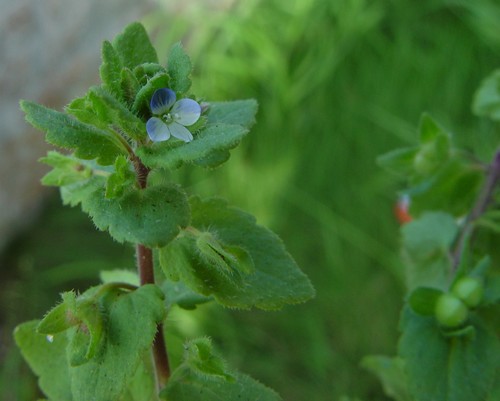
Veronica agrestis L. is an annual speedwell with a sprawling growth habit. Its flowers are predominantly white to light blue, sometimes lilac, and the plant has fresh green leaves. The small flowers measure 3–6 mm in diameter; typically, the lower portion of each flower is white or pale, while any prominent visible color appears on the uppermost portion. Flower stalks are moderately short, and are not clearly longer than the leaves. When mature, the stalks bear a fruit capsule with two parallel lobes; the capsule is covered in long hairs or completely hairless, but never has short hairs. Both the lower and upper leaves have a somewhat elongated shape. It can be distinguished from similar species: Veronica polita has dull green leaves, non-elongated lower leaves, and fruit capsules that bear both short and long hairs; Veronica persica has flower stalks that are often much longer than the leaves, and fruit capsule lobes that diverge in a V-shape.
This species is native to Europe, western Asia, and North Africa. It has been introduced to Albania, Algeria, Austria, the Azores, the Baltic States, Belarus, Belgium, Bulgaria, the Canary Islands, Central European Russia, Corsica, Czechoslovakia, Denmark, East European Russia, Finland, France, Germany, Greece, Hungary, Italy, Crete, Libya, Madeira, Morocco, the Netherlands, Northwest European Russia, Norway, Palestine, Poland, Portugal, Romania, Sardinia, Sicily, South European Russia, Spain, Sweden, Switzerland, Tunisia, Ukraine, Yugoslavia, Alabama, Assam, Bangladesh, Bermuda, the District of Columbia, the Falkland Islands, Florida, Great Britain, Haiti, Illinois, India, Ireland, Kentucky, Louisiana, Maryland, Massachusetts, Mauritius, New York, Newfoundland, the Northern Provinces, Nova Scotia, Pennsylvania, Québec, Réunion, St. Helena, Texas, Tristan da Cunha, Turkmenistan, and Vermont. In Europe, it grows on cultivated ground and is somewhat of a calcifuge. In the United States, it occurs in light, non-calcareous, moist, gravelly soils at elevations between 300 and 800 m.