About Vernonia noveboracensis (L.) Willd.
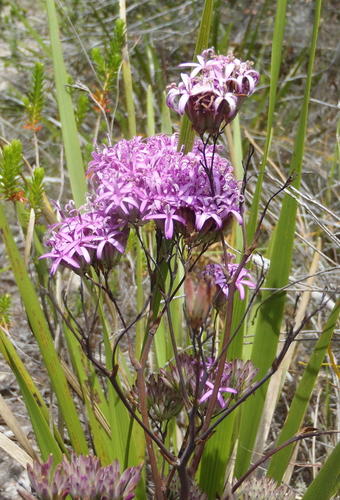
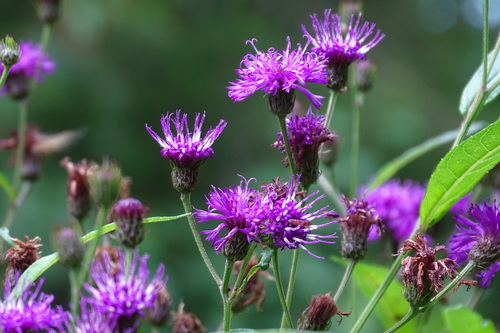
Vernonia noveboracensis (L.) Willd., commonly called ironweed, is a deciduous herbaceous clumping perennial. It has stiff greenish-purple stems that hold alternate, simple leaves, and most plants grow to around 6 feet tall, reaching this maximum height between two and five years after germination. The species grows at a moderate rate, produces multiple stems per plant, and spreads via seed. It can become aggressive when growing in moist soils, but is not known to be an invasive species. Compared to other species in the genus Vernonia, such as Vernonia acaulis, Vernonia noveboracensis has longer stems. Its flowers are purple, made up of small, compact clusters of florets, and bloom from summer through fall, with peak blooming in August. Its seeds are brown, and it produces small, bristly-covered fruits called achenes that are dispersed by wind. This plant can grow in chalk, clay, and loam soils with pH ranging from acid to alkaline. Ecologically, it grows in wetlands and moist soils, and has a wetland indicator status of FAC+. Its active growth occurs during the summer, and it can survive minimum temperatures as low as −33 °F (−36 °C). It competes with other plants via its early season growth and tall stem height, and its stiff hard stem allows it to withstand windy conditions. It is not toxic, attracts butterflies, birds, and other insects, and is resistant to deer. A sesquiterpene lactone called dihydromikanolide, which is useful for treating infections, has been found in this species. Historically, Native Americans used its leaves to prepare a tea that relieved labor pain and acted as a blood tonic, and made tea from its roots to relieve stomach ulcers and tooth pain.