About Vernonia missurica Raf.
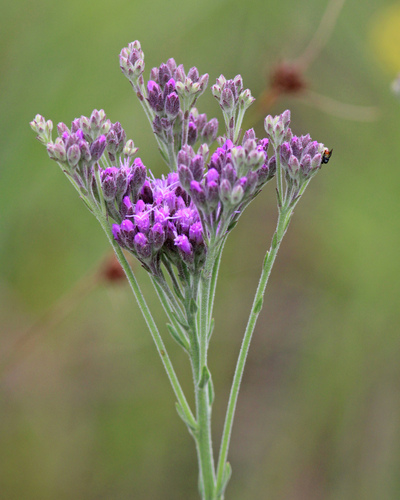
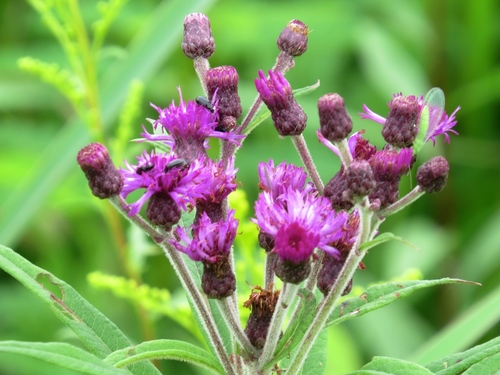
Vernonia missurica Raf. is typically 90–150 cm (3–5 ft) tall and 90–120 cm (3–4 ft) wide, and in some cases it can exceed 180 cm (6 ft) in height. It has dark green, alternately arranged leaves. The stout central stem of this species is covered in white hairs; the stems overall are hairy and reddish-brown. Flowering occurs between July and August. The blooms are magenta, and are accompanied by reddish-brown bracts. Each flower head is rayless, grows close to other heads, measures 100–180 mm (4–7 in) in length and 15 mm (1⁄2 in) in diameter, and holds 30–60 disk florets. This species is native to the central and east-central United States, specifically the states of Alabama, Arkansas, Georgia, Illinois, Indiana, Iowa, Kansas, Kentucky, Louisiana, Michigan, Mississippi, Missouri, Oklahoma, Tennessee, and Texas. It grows in habitats including river bottom woods, wet prairies, fens, and sedge meadows. Its most frequent visitors are long-tongued bees, butterflies, and skippers. It is capable of self-pollinating if these pollinators are not present. Confirmed pollinators include multiple groups of bees: bumblebees of the genus Bombus, epeoline cuckoo bees of the tribe Epeolini, halictid bees of the family Halictidae, and miner bees of the genus Andrena. Butterflies (Lepidoptera) and skippers of the family Hesperiidae are also common visitors. Several species of caterpillars feed on this plant, most commonly the caterpillars of Grammia parthenice (Parthenice tiger moth), Perigea xanthioides (red groundling), and Papaipema cerussata (ironweed borer moth). Herbivorous mammals avoid this plant because of its bitter taste.