About Verbena hastata L.
Verbena hastata L. (V. hastata) produces a stiffly erect stem that occasionally branches in the upper half of its growth, and reaches up to 1.5 meters (5 feet) in height. Its stems are four-angled (square), hairy, and range in color from green to reddish. The leaves are arranged oppositely and are simple, growing up to 15 cm (6 inches) long and 3 cm (1 inch) across. Leaves have doubly-serrate margins, come in shapes from lanceolate to ovate, and may bear 2 lateral lobes.
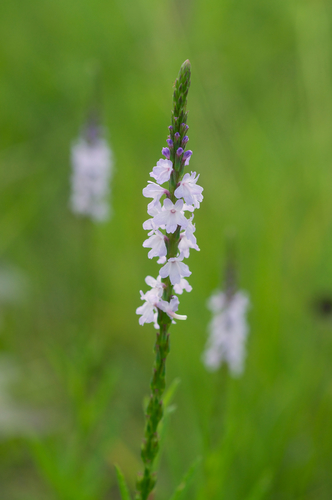
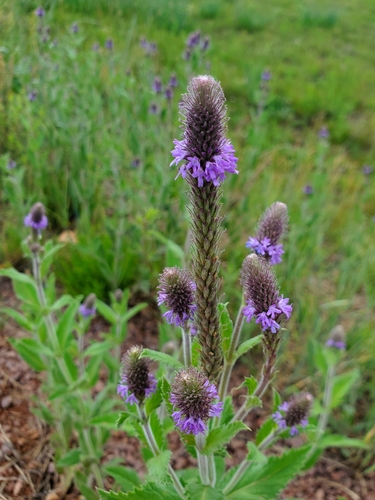
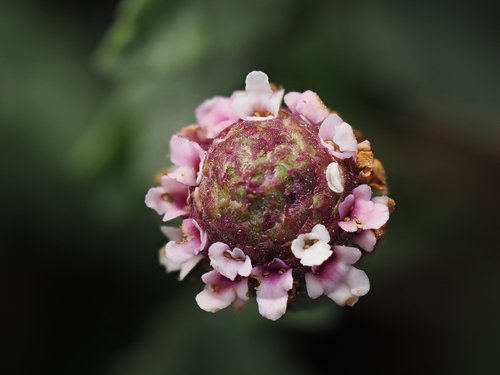
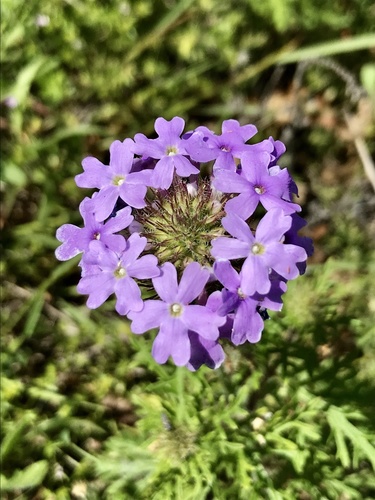
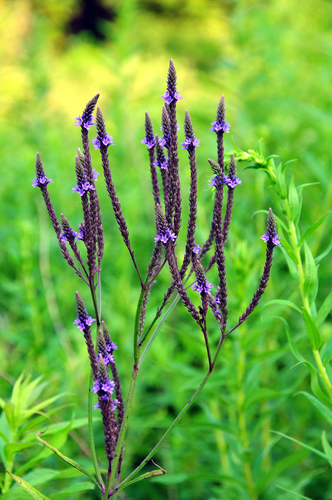
The inflorescence is a panicle (a group of flowering spikes) that grows up to 30 cm (1 foot) long at the tips of upper stems. Each flowering spike within the panicle can reach 13 cm (5 inches) long, and holds numerous densely packed, 5-lobed flowers that are up to 1 cm (0.25 inches) long. Flowers are violet or deep purple, and very rarely white. They open starting from the bottom of the spike moving upward, with only a small ring of flowers open at any one time.
V. hastata is native to the contiguous United States (all states except Alaska and Hawaii), and native to the Canadian provinces of British Columbia, Saskatchewan, Manitoba, Ontario, Quebec, New Brunswick, Nova Scotia, and Prince Edward Island. This plant prefers moist conditions, and most often grows in wet meadows, wet river bottomlands, stream banks, slough peripheries, fields, and waste areas. It is adapted to wetland environments and can spread to form small colonies.
Flowering occurs from mid- to late summer. The species attracts bees, and acts as a larval host for the common buckeye butterfly (Junonia coenia), the verbena moth (Crambodes talidiformis), and the verbena bud moth (Endothenia hebesana).