About Verbena brasiliensis Vell.
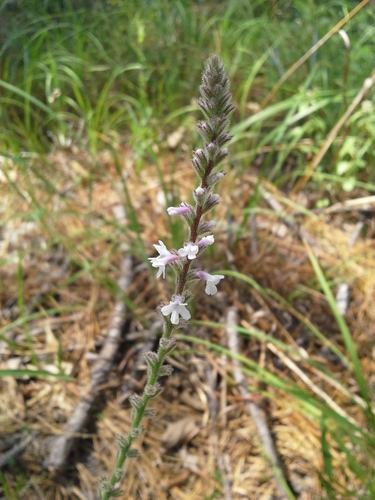
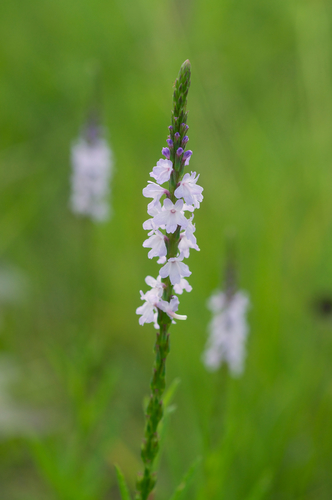
Verbena brasiliensis Vell. is an erect plant that grows as a forb, herb, or subshrub. Its stems typically reach around 1 meter in height; they are mostly glabrous (smooth) on the lower portion and scabrous-pubescent (rough and hairy) on the upper portion. Lower branches are arranged oppositely along the stem, while upper branches grow in an irregular pattern, and the stem is slightly indented at the nodes.
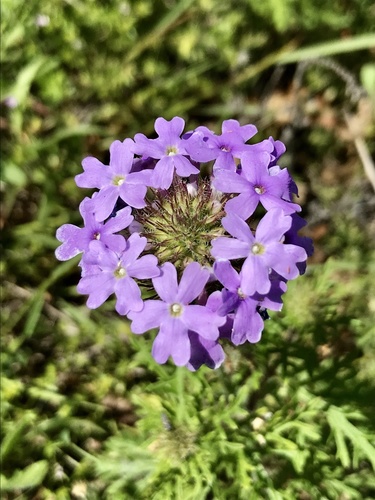
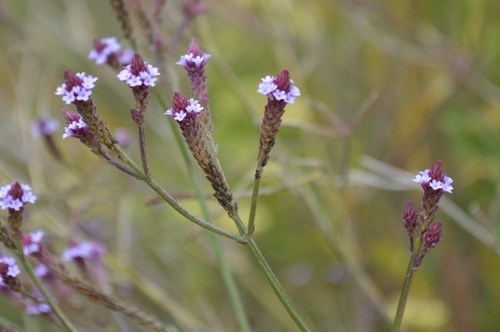
Leaves of Verbena brasiliensis are serrated, membranaceous, have connate bases, and are slightly pubescent (hairy) on their underside. This species has terminal inflorescences, with flowers grouped closely together. Flowers are usually purplish, and are bisexual (possessing both male and female reproductive organs). The calyx of each flower is tubular, five-lobed, and approximately 3 mm long; nerves on the calyx extend past the lobes to form teeth, with the posterior nerve always being the shortest. The corolla is made of fused petals that open at the end, and is just slightly longer than the calyx. The ovary is superior and bicarpellary.
Fruits of Verbena brasiliensis are overlapping schizocarps, a type of dry fruit that splits when mature. Fruits stay encased in the calyx until release, which occurs through the shortest posterior nerve of the calyx. Each fruit produces four nutlets (two per carpel), each around 2 mm long with a triangular cross section. Verbena brasiliensis reproduces sexually through seed production.
Verbena brasiliensis is frequently confused with Verbena litoralis, as the two species grow in similar habitats, but they can be easily distinguished by their differing inflorescences: Verbena brasiliensis has short, compact spikes arranged in open cymes, while Verbena litoralis has longer spikes arranged in paniculate cymes.
Verbena brasiliensis is native to South America, where it occurs naturally in Argentina, Bolivia, Brazil, Chile, Colombia, Ecuador, Paraguay, Peru, and Uruguay. In its native range, it grows in dry conditions on agricultural fields and is considered a weed. It has now spread to many other regions, including North America, Oceania, Africa, Asia, and Europe, where it is widely considered invasive. In invasive ranges, it grows well in man-made areas and riverine environments. In the United States, it occurs in Oregon, California, Texas, Oklahoma, Missouri, Arkansas, Louisiana, Kentucky, Tennessee, Mississippi, Alabama, Georgia, Florida, South Carolina, North Carolina, Virginia, and Hawaii, and grows mainly in grasslands, rangelands, riparian zones, urban areas, and wetlands.
Verbena brasiliensis has been used as a garden and ornamental plant. It has been cultivated for aesthetic purposes both within and far outside of its native range.