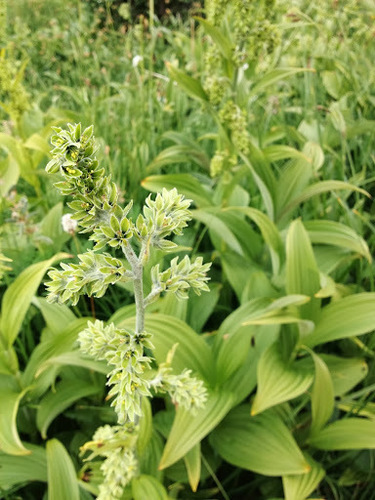
About Veratrum viride Aiton
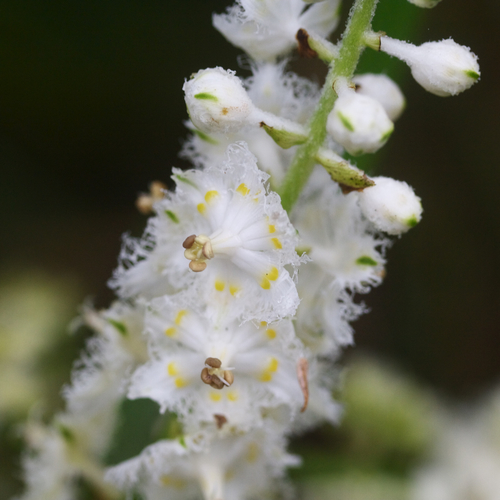
Veratrum viride Aiton is a herbaceous perennial plant that grows 0.7 to 2 metres (2.3 to 6.6 ft) tall, with a solid green stem. Its leaves are arranged spirally, measure 10 to 35 cm (4 to 14 in) long and 5 to 20 cm (2 to 8 in) wide, and are shaped elliptic to broad lanceolate, ending in a short point. The leaves are heavily ribbed and hairy on the underside. This species produces numerous flowers arranged in a large branched inflorescence that is 30 to 70 cm (1.0 to 2.3 ft) tall; each individual flower is 5 to 12 mm (0.2 to 0.5 in) long, with six green to yellow-green tepals. The fruit is a capsule 1.5 to 3 cm (0.6 to 1.2 in) long, which splits into three sections when mature to release numerous flat seeds with a diameter of 8 to 10 mm (0.3 to 0.4 in). It reproduces both via rhizome growth and seeds. Two varieties of Veratrum viride have distinct ranges in North America. Varietas viride grows in eastern North America, ranging from southwestern Labrador and southern Quebec south to northern Georgia. Varietas eschscholzianum grows in western North America, ranging from Alaska and the Northwest Territory south through Yukon, British Columbia, Alberta, Washington, Idaho, Montana, and Oregon to northwestern California (Del Norte, Siskiyou, Trinity, and Humboldt Counties). The species grows in wet soils in meadows, sunny streambanks, and open forests. Its elevation range extends from sea level in the northern part of its distribution, up to 1,600 metres (5,200 ft) in the southeast of its range, and up to 2,500 metres (8,200 ft) in the southwest. Veratrum viride is highly toxic. It causes nausea and vomiting; if the poison is not expelled, affected people develop cold sweat and vertigo, followed by slowed respiration, and drops in cardiac rhythm and blood pressure. The toxic effects of the plant's veratrum alkaloids are caused directly by antagonism of adrenergic receptors. Several Native American nations use the plant externally. It is rarely used in modern herbalism due to its high concentration of various alkaloids, but it was used historically to treat high blood pressure and rapid heartbeat. A standardized extract of V. viride alkaloids called alkavervir was used as an antihypertensive in the 1950s and 1960s. The plant's root contains higher concentrations of alkaloids than its above-ground aerial parts.