About Veratrum album L.
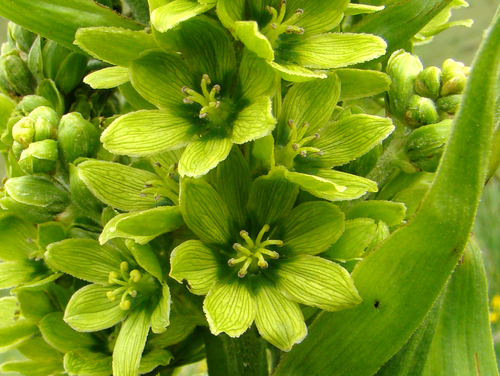
Veratrum album L. is a tall herbaceous perennial plant. It has alternate, pleated leaves, and bears white flowers marked with green on the upper portion of its stalk. Its fruit is a small pod that holds winged seeds. The plant has stout, unbranched stems that grow between 50 and 175 cm (20 to 69 inches) tall. It is estimated to live for several centuries, and often becomes the dominant species in wild areas because grazing herbivores find it unpalatable. All parts of Veratrum album are poisonous. It has been mistaken for the harmless yellow gentian (Gentiana lutea) or wild garlic (Allium ursinum) when added to beverages, leading to poisoning incidents. In 1982, Veratrum alkaloids from this plant were included in a German sneezing powder, which is commonly used for pranks, causing accidental poisoning in users. In 1983, nine accidental poisoning cases occurred from these prank products: the victims were nine boys aged 11 to 18 years old in Scandinavian countries, who had used powder imported from the Federal Republic of Germany. All nine boys inhaled the powder, and six also ingested it. Symptoms typically appeared within an hour, after which authorities were contacted. After sneezing, all victims developed gastrointestinal disturbances, with vomiting reported in all cases and epigastric pain in two. Three children collapsed from low blood pressure before being admitted to hospital. Seven children had significantly lowered blood pressure, and five had sinus bradycardia with no other heart irregularities. Half of the victims who ingested the powder received gastric lavage treatment. Four boys were given atropine to treat bradycardia, and one received activated charcoal. Atropine normalized their heart rates within minutes but did little to improve low blood pressure. All patients recovered within 24 hours. Three more accidental poisoning cases were reported in 2005 and 2008. In 2009, eleven children aged 8 to 12 years old accidentally ingested Veratrum album at a youth camp, where they made homemade tea from fresh wild-harvested herbs. Two children stayed asymptomatic, nine developed mild gastrointestinal symptoms, six had neurological symptoms, and three developed bradycardia; all children recovered after receiving medical care. In 2010, four accidental poisoning cases were reported after Veratrum album was mistaken for wild garlic and used in homemade salads and soups. All victims developed nausea, vomiting, abdominal pain, sinus bradycardia, and hypotension. Full recovery took between 24 and 48 hours. Extracts from dried rhizomes of Veratrum album were briefly used as a pesticide to target the Colorado potato beetle.