About Veniliornis spilogaster (Wagler, 1827)
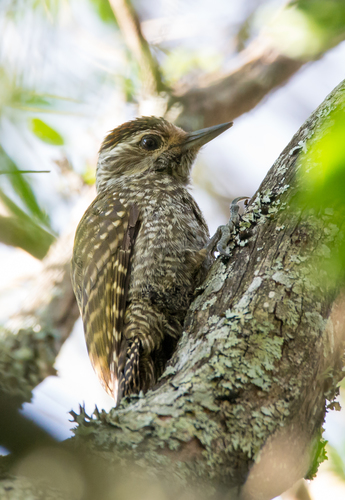
Veniliornis spilogaster, commonly called the white-spotted woodpecker, measures 16 to 19.5 cm (6.3 to 7.7 in) in length and weighs 35 to 45 g (1.2 to 1.6 oz). Males and females share the same plumage pattern except for markings on the head. Males have a buffy to olive forehead, a blackish brown crown with very narrow red streaks, and an olive-green hindneck. Females have an olive-brown crown with fine white spots. Adult individuals of both sexes have a mostly brownish face marked with a thin white supercilium, a thin white "moustache", and scattered white speckles. Their upperparts are mostly olive-green; yellowish to white feather edges appear as bars from a distance. Their flight feathers are dark brown with whitish bars. Their tail is dark brown, with narrow off-white bars on each feather. Their underparts are dark olive, with heavy yellowish white streaks on the throat, yellowish white bars or spots on the breast, and heavy yellowish white bars on the belly and undertail coverts. The iris is deep chestnut brown, the beak is blackish gray with a paler base, and the legs are olive or olive-gray. Males have a longer bill than females. Juveniles are very similar to adults, but have fainter, less regular barring on their upperparts. The white-spotted woodpecker's distribution ranges from Goiás and Minas Gerais in Brazil, south through southeastern Paraguay and most of Uruguay, into northeastern Argentina as far as Entre Ríos Province. It occupies a variety of wooded landscapes, including humid lowland forest, gallery forest, isolated forest patches, open to very open woodland, and lightly wooded parks.