About Veniliornis mixtus (Boddaert, 1783)
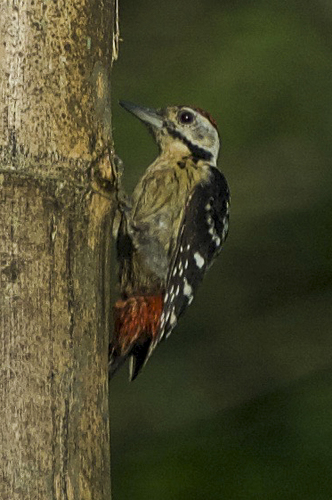
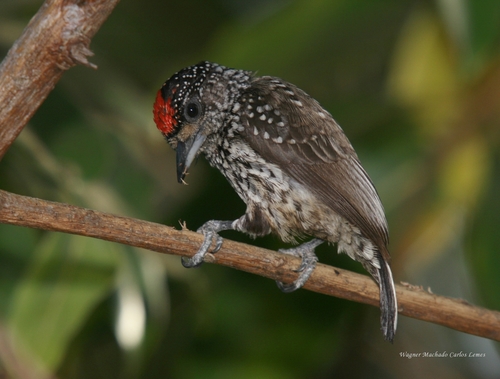
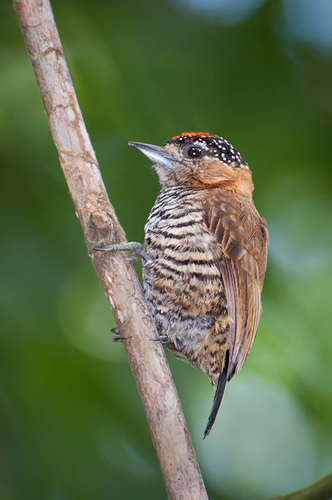
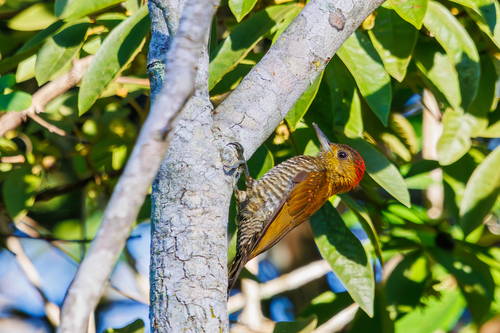
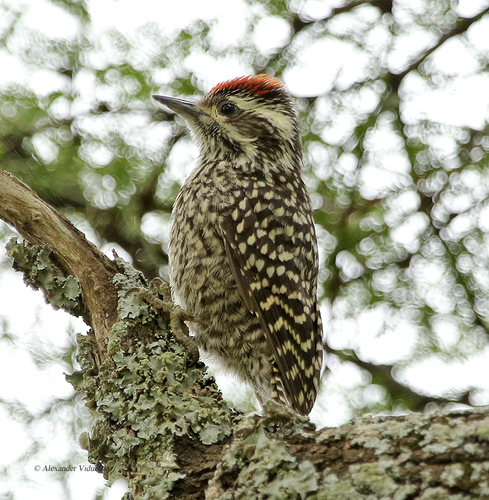
The checkered woodpecker, scientific name Veniliornis mixtus (Boddaert, 1783), measures about 14 cm (5.5 in) long and weighs between 30 to 37 g (1.1 to 1.3 oz). Males and females have identical plumage except for patterns on their heads. For the nominate subspecies V. m. mixtus, adult individuals of both sexes have a blackish-brown forehead and crown, blackish-brown hindneck, and generally white face with a dark brown stripe running back from the eye, plus a thin dark brown malar stripe. Males of the nominate subspecies have white or buffish white streaks on the crown and a red or orange-red nape. The female's nape is black where the male's is red, and the female's crown is solid black. The upperparts of both sexes are blackish-brown, marked with whitish or brownish-white bars. Their flight feathers are deep brown with white bars, their tail is brownish-black with narrow white bars, and their underparts are white with a yellow or buff tinge. The underparts also have dark brown streaks on the breast and belly, brown bars on the flanks, and thin brown streaks on the undertail coverts. Juvenile checkered woodpeckers are duller and darker than adults, with broken bars on their upperparts and heavy streaks and bars on their dull white underparts. Both juvenile male and juvenile females have red on the crown rather than the nape, though the female's red patch is smaller than the male's. Subspecies V. m. berlepschi is similar to the nominate subspecies, but its brown-colored areas are somewhat darker, the patch behind its eye is larger, and its underparts are a purer white. V. m. malleator is similar to V. m. berlepschi but has heavier streaking on the underparts. V. m. cancellatus is a distinctive subspecies. It is much browner than the nominate, especially in areas that are black on the nominate, such as the crown. The white bars on its upperparts are much wider than the brown bars, and its underparts have much more white with fewer and smaller streaks than the nominate's underparts. The subspecies intergrade, and it has been noted that malleator and berlepschi may be more appropriately lumped into the nominate subspecies. Checkered woodpecker subspecies have the following distributions: V. m. cancellatus (Wagler, 1829) is found from extreme eastern Bolivia into eastern and southern Brazil. V. m. mixtus (Boddaert, 1783) is found in eastern Argentina, extreme southeastern Brazil, and western Uruguay. V. m. malleator (Wetmore, 1922) is found in the Chaco Basin of southeastern Bolivia, western Paraguay, and northern Argentina. V. m. berlepschi (Hellmayr, 1915) is found in central and eastern Argentina. The checkered woodpecker primarily inhabits humid open woodlands and gallery forest, but it also occurs in savanna and cerrado woodlands. Subspecies V. m. berlepschi inhabits arid bushlands characterized by Prosopis mesquite. Across the species, elevation ranges from near sea level to about 600 m (2,000 ft). Subspecific differences in this species run contrary to Gloger's rule: V. m. malleator and V. m. berlepschi, which inhabit more arid habitats, have darker and more prominent underside patterning, while the other two subspecies, which live in mesic or riparian woodland, are paler overall.