About Veniliornis maculifrons (von Spix, 1824)
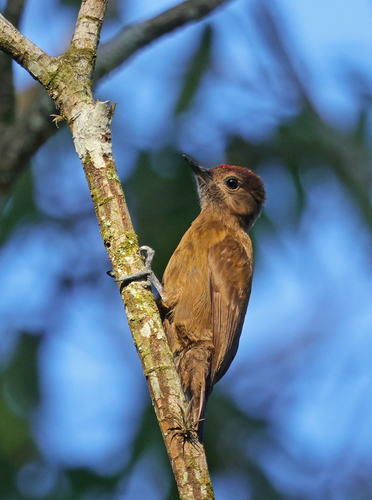
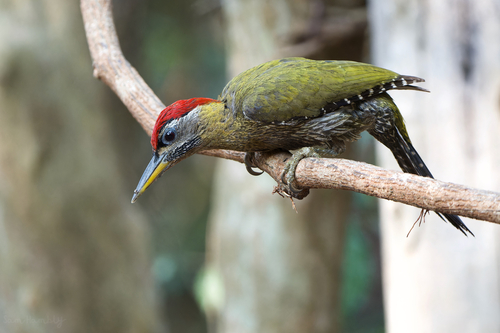
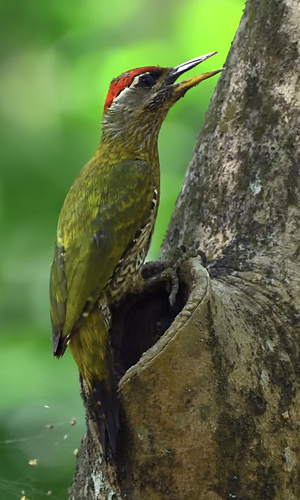
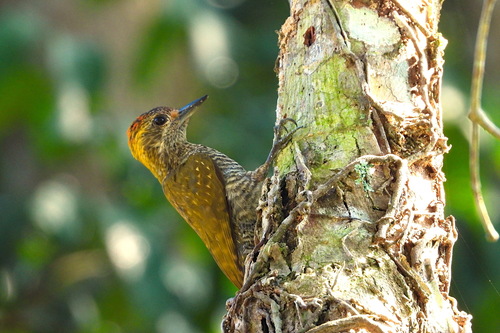
Yellow-eared woodpecker, with the scientific name Veniliornis maculifrons (von Spix, 1824), has a total length of approximately 15 cm (5.9 in). Males and females share identical plumage across most of their bodies, differing only in the coloration of the head. Males have a brown crown marked with white streaks and some red feather tips, paired with a mostly red hindcrown. Females have an olive crown with pale spots, and golden tips on feathers of the rear crown. Both adult sexes have a mostly olive-brown face with whitish streaks, and a pale golden-yellow nape. Their upperparts are mostly yellowish green, sometimes with a bronzy tint, and marked with yellowish spots and bars, particularly on the rump. Their flight feathers are darkish brown with pale yellow to white bars. Their tail is dark brown, with paler bars present on most feathers. Their underparts are off-white with narrow olive bars; these bars are wider on the breast and flanks. The iris ranges from dark brown to reddish, the long beak is blackish with a paler base, and the legs are olive or gray. Juvenile yellow-eared woodpeckers are duller in color than adults, have heavier barring on their upperparts, and coarser barring on their underparts. This species is found in eastern Brazil, between the states of Bahia and Rio de Janeiro. It inhabits lowlands and hills of the Atlantic Forest, including both primary and secondary growth, and also occurs in parks.