About Veniliornis kirkii (Malherbe, 1845)
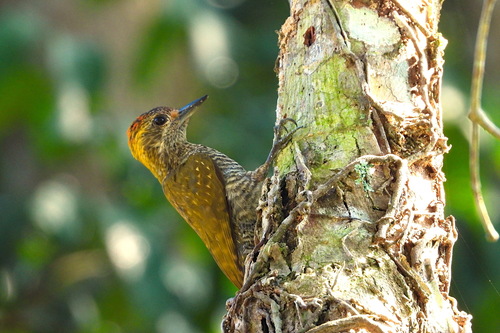
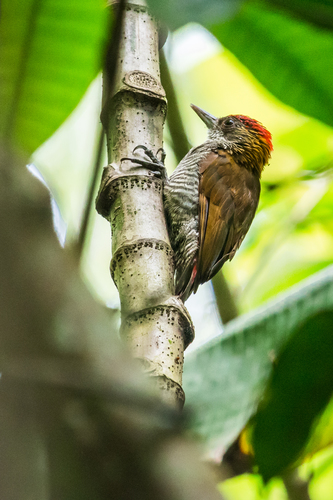
The red-rumped woodpecker (Veniliornis kirkii) is 15 to 16 cm (5.9 to 6.3 in) long and weighs 30 to 42 g (1.1 to 1.5 oz). Male and female plumage is identical except for head patterning. For the nominate subspecies V. k. kirkii, males have a red crown and nape, with some dusky brown or dark gray feather tips. Females of this subspecies have a dark brown crown with a faint green tinge. Adults of both sexes of the nominate subspecies have mostly olive-brown faces marked with whitish streaks. Their upperparts are mostly golden olive-brown with some yellow and red feather tips, plus a crimson-red rump and crimson-red uppertail coverts. Their flight feathers are dark brown with greenish-olive edges. Their tails are dark brown, with pale buff bars on the outermost pairs of tail feathers. Their underparts have alternating dark brown and whitish bars, with whitish bars becoming wider on the belly. This species has a dark brown to red-brown iris, a moderately elongated blackish beak with a paler lower mandible, and grayish legs that carry a green to blue tinge. Juvenile red-rumped woodpeckers resemble adults, but both sexes have some red on the crown, with males showing more red than females. Five subspecies are recognized, with distinct physical and geographic differences: Subspecies monticola is larger than the nominate and has heavy blackish barring on its underparts. Subspecies continentalis is smaller than the nominate, has more yellow on its nape, and wider pale bars on its underparts. Subspecies cecilii is smaller than continentalis; compared to the nominate, it has less pattern on the chin and throat and more barring on the tail. Subspecies neglectus is brighter on its upperparts and darker on its underparts than the nominate. Each subspecies occupies a separate range within the species' overall distribution. V. k. neglectus is found in southern Costa Rica and western Panama, including Coiba Island. V. k. cecilii ranges from eastern Panama south through western Colombia and western Ecuador into extreme northwestern Peru. V. k. continentalis is found in western and northern Venezuela. V. k. monticola occurs in the tepui region, where the borders of central and southeastern Venezuela, western Guyana, and extreme northwestern Brazil meet. The nominate V. k. kirkii is found on the Paria Peninsula of northeastern Venezuela, and on the islands of Trinidad and Tobago. The red-rumped woodpecker inhabits a wide variety of mostly relatively open lowland and foothill habitats. These include wet forests, secondary forests, mangrove edges, gallery forests, dry scrublands, deciduous forests, savannas with scattered trees, and coconut plantations. The maximum elevation the species reaches varies by region: it occurs up to 900 m (3,000 ft) in Panama, 1,000 m (3,300 ft) in western Venezuela, 1,200 m (3,900 ft) in Ecuador, 1,500 m (4,900 ft) in Peru, and 1,750 m (5,700 ft) in the tepui region.