About Veniliornis frontalis (Cabanis, 1883)
This species, the dot-fronted woodpecker, has the scientific name Veniliornis frontalis (Cabanis, 1883).
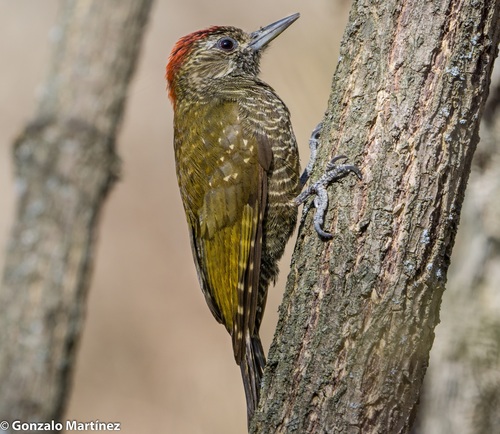
Adults of the dot-fronted woodpecker measure about 16 cm (6.3 in) in length and weigh between 30 and 40 g (1.1 to 1.4 oz). Males and females share the same plumage pattern everywhere except on the head. Males have an olive to gray-brown forehead (the "front" for which the species is named) covered in many white spots, with red coloring from the crown to the nape, where dark gray feather bases are visible through the red plumage. Females have an olive-brown color from the forehead to the nape, with white spots across the entire area. Both adult sexes have a mostly olive-brown face, marked with a thin white supercilium and a thin white "moustache" stripe. Their upperparts are mainly yellowish olive, with golden feather tips and pale bars and streaks. Their flight feathers are brown, with wide yellow-green edges and pale bars on the inner webs. Their tail is dark brown, with a yellow wash and thin whitish bars across the individual feathers. Their underparts are olive-gray with narrow whitish bars. The iris is dark brown; the moderately long beak is blackish with a paler lower mandible; and the legs are dark gray. Juveniles are duller and grayer than adults. Both juvenile sexes have some red on the crown, with males showing more red than females.
The dot-fronted woodpecker is distributed along the eastern side of the Andes Mountains, ranging from the Cochabamba and Santa Cruz departments of Bolivia south to Tucumán Province in Argentina. It lives in dry montane woodland, humid forest, and the transition zone between these two habitat types. It can be found at elevations up to 2,000 m (6,600 ft), though it generally occurs at lower elevations.