About Veniliornis callonotus (Waterhouse, 1841)
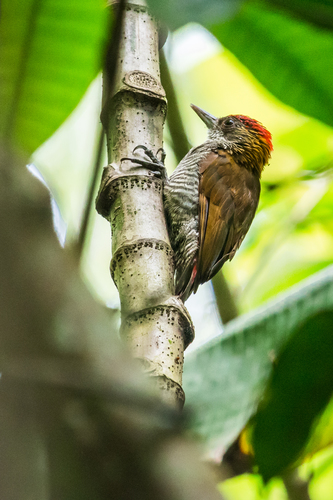
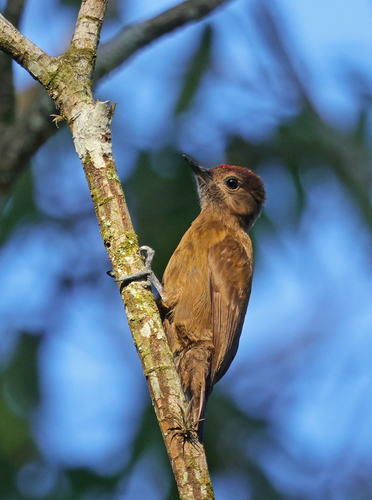
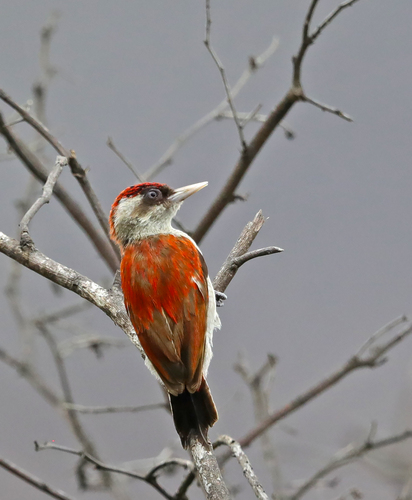
This species is the scarlet-backed woodpecker, with the scientific name Veniliornis callonotus (Waterhouse, 1841). The scarlet-backed woodpecker measures about 13 cm (5.1 in) in length and weighs between 23 and 33 g (0.81 to 1.2 oz). Males and females have identical plumage except for the coloration of their heads. For the nominate subspecies, adult individuals of both sexes have a generally grayish brown and white face. Males are red from the forehead to the nape, with many feathers having black tips. Females have entirely black coloration in this same head region. The upperparts of both sexes are brownish-scarlet. Their flight feathers are dark brown, with redder secondaries and tertials. Their tail is blackish-brown; the central pair of tail feathers is darker black, and the outer pair is whitish yellow with black bars. Their underparts are white with a very light buff wash, and sometimes have faint, darker vermiculation. The iris is deep brown, and occasionally deep red; the beak is yellowish with a darker base and tip; and the legs are greenish gray. Juveniles have heavy olive or grayish mottling on their upperparts, and their underparts are a buffier white than adults. Their head pattern is more diffuse than that of adults. Adults of the subspecies V. c. major have a darker face and darker underpart vermiculation than the nominate subspecies. The nominate subspecies of scarlet-backed woodpecker ranges from Nariño Department in Colombia, south through western Ecuador to Guayas Province. V. c. major ranges from El Oro and Loja provinces in Ecuador, south into Peru as far as La Libertad Department. The species inhabits arid scrublands, dry deciduous woodland, semi-humid forest, dense riparian forest, and sometimes partially cleared areas. In terms of elevation, it mostly occurs from near sea level up to 1,000 m (3,300 ft). It is found less frequently up to 1,500 m (4,900 ft) in Peru, and occurs locally as high as 1,800 m (5,900 ft) in Ecuador.