About Veniliornis affinis (Swainson, 1821)
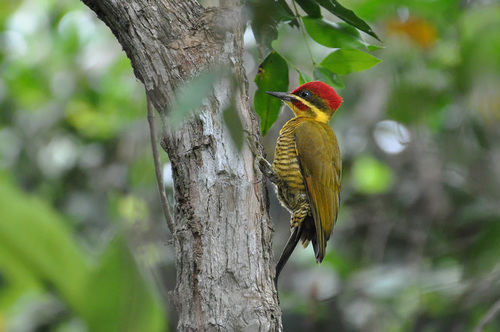
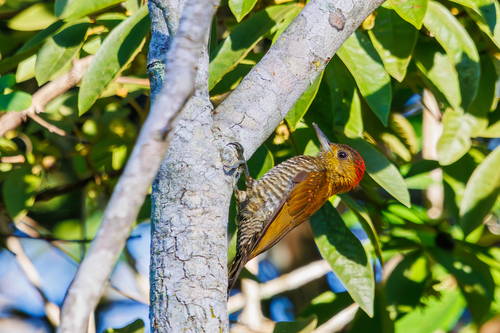
The red-stained woodpecker (Veniliornis affinis) has a body length of approximately 15 to 18 cm (5.9 to 7.1 inches) and weighs 32 to 44 g (1.1 to 1.6 oz). Male and female red-stained woodpeckers have identical plumage except for the coloration of their heads. For the nominate subspecies V. a. affinis, males have a red crown with visible black feather bases, while females have a dark olive-brown crown. Adult birds of both sexes have a mostly buffish face marked with olive streaks, and golden-yellow nape and hindneck. Their upperparts are mainly yellowish green, with some red feather tips, pale yellow streaks, and some barring on the rump and uppertail coverts. Their flight feathers are dark brown, with wide green edges and buffish white bars on the primaries and secondaries. Their tail is dark brown, with yellowish bars on most feathers. Their underparts are light cinnamon-buff with dark olive-brown bars, which are more widely spaced on the belly and flanks. The iris ranges from brown to red-brown, the fairly long beak is blackish with a paler lower mandible, and the legs are olive green to green-gray. Juvenile birds resemble adults but have a darker, more heavily streaked face; both juvenile males and females have some red on the crown, with males having more red than females. The subspecies orenocensis has greener upperparts with less red than the nominate subspecies. Subspecies hilaris is larger than the nominate, with more bronzy or yellow upperparts that have fainter streaks, and broad red tips on the wing coverts. Subspecies ruficeps is the same size as hilaris, with larger red tips on the cover feathers and more obvious yellow streaks on the upperparts. The four subspecies of red-stained woodpecker have separate distributions across South America: V. a. orenocensis is found in southeastern Colombia, far southern Venezuela, and the area of Brazil north of the Amazon extending as far as the Rio Negro; V. a. hilaris ranges from eastern Ecuador east into western Brazil to the Rio Madeira, and south through eastern Peru into northern Bolivia; V. a. ruficeps occurs in central and northeastern Brazil south of the Amazon, east of the Rio Madeira, and south to Mato Grosso; V. a. affinis (the nominate) is restricted to the eastern Brazilian states of Alagoas, Pernambuco, and Bahia. The red-stained woodpecker mainly lives in the interior of tall rainforest. It is less common at forest edges, in secondary forest, and in scrublands. In Ecuador and Peru, it also inhabits humid lowland terra firme, and sometimes várzea forests. It occasionally forages in more open landscapes. Its elevation range varies by country: it occurs between 100 and 500 m (300 and 1,600 ft) in Venezuela, up to 1,000 m (3,300 ft) in Colombia, up to 850 m (2,800 ft) in Ecuador (but usually only up to 600 m (2,000 ft)), and up to 1,300 m (4,300 ft) in Peru.